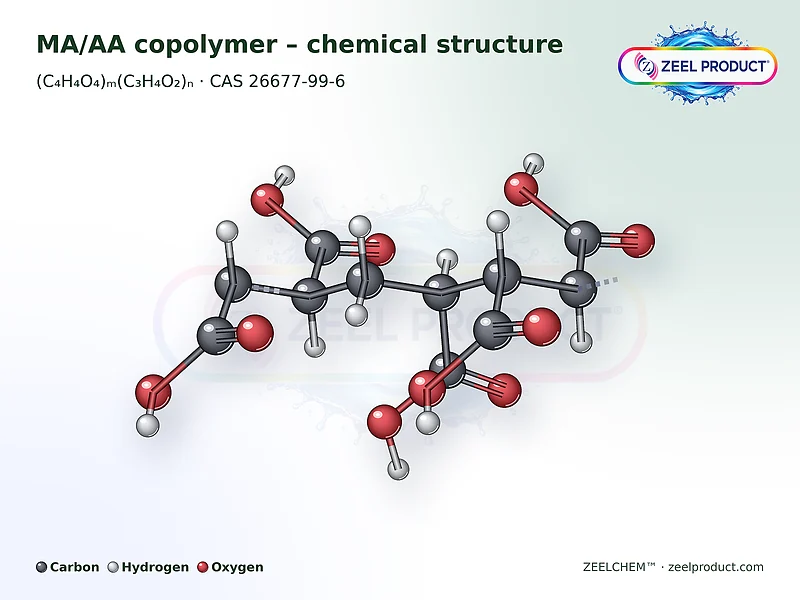
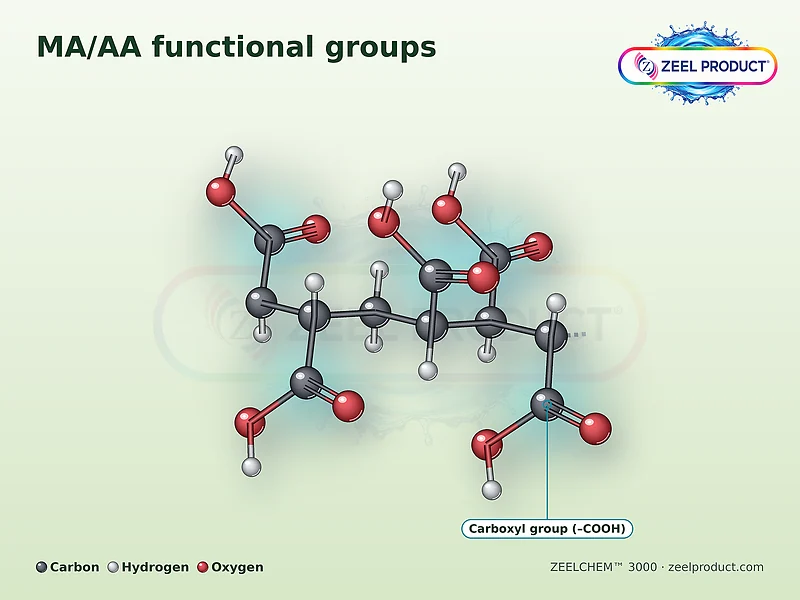
Quick answer: Calcium tolerance is a polymer's ability to stay soluble in hard, high-pH water. Carboxylate-only polymers such as PAA can form insoluble calcium–polymer salts when calcium, pH and dose are high, losing performance and even causing deposits. Copolymers like MA/AA (ZEELCHEM™ 3000) and sulphonated polymers like AA/AMPS (3100) and terpolymer (7000) have much higher calcium tolerance.
What is calcium tolerance?
Anionic polymers bind calcium. That is part of how they work. But if too much calcium binds, the polymer–calcium complex can become insoluble and precipitate. This is usually seen as turbidity in a jar test, or as a soft, gummy deposit in a high-cycle cooling tower.
What increases the risk
- High calcium hardness (> 800–1,000 mg/L as CaCO₃).
- High pH (> 8.8).
- High temperature.
- High polymer dose: precipitation can get worse as the dose increases.
- Higher molecular weight homopolymers.
Simple calcium tolerance test
- Prepare water with high calcium (e.g. 1,000 mg/L as CaCO₃) at pH 9.0.
- Add polymer at several doses (10, 25, 50, 100 mg/L).
- Heat to 60 °C for 30 min and measure turbidity (NTU).
- The dose at which turbidity rises sharply is the "cloud point". A higher cloud point means better tolerance.
Calcium tolerance ranking
| Polymer | Relative calcium tolerance |
|---|---|
| PAA (1000) | Moderate |
| HPMA (200) | High |
| MA/AA (3000) | High |
| AA/AMPS (3100) | Very high |
| Terpolymer (7000) | Very high |
How to avoid polymer drop-out
- Use a calcium-tolerant copolymer or sulphonated polymer at high cycles.
- Do not overdose: more is not always better.
- Keep cycles within the program's LSI limit. See LSI explained.
- Dose continuously rather than in slugs.
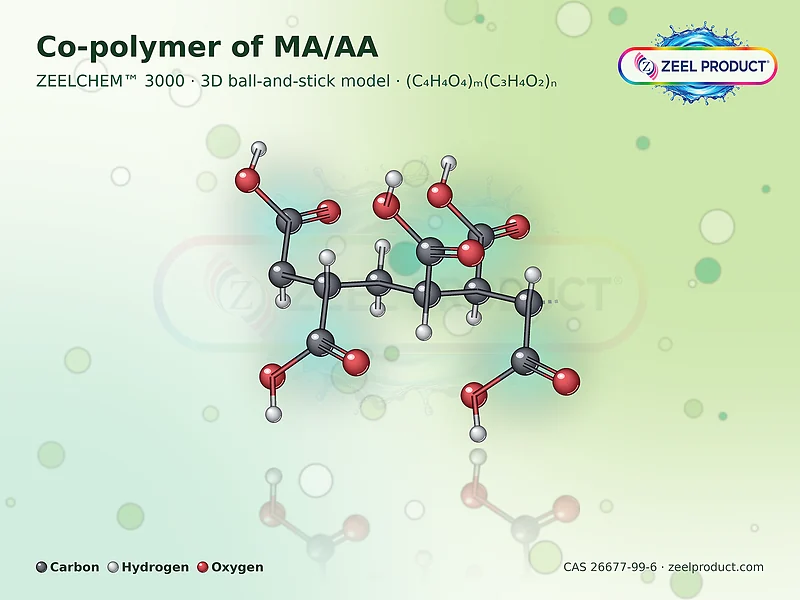 FEATURED PRODUCT
ZEELCHEM™ 3000 – Co-polymer of MA/AA
Maleic–acrylic copolymer for high-hardness, high-alkalinity water: calcium carbonate inhibition plus dispersion.
FAQ
Can overdosing polymer cause deposits?
Yes. In hard, high-pH water, excess carboxylate polymer can precipitate with calcium.
Which polymer has the best calcium tolerance?
Sulphonated polymers such as AA/AMPS and terpolymers.
How do I know if my polymer is precipitating?
Turbidity in jar tests, low polymer residual and soft gummy deposits are all signs.
More from ZEEL PRODUCT: zeelproduct.com · zeelproduct.net · ZEELCHEM™ range · online shop · zeelproductonline.co.in