Structure
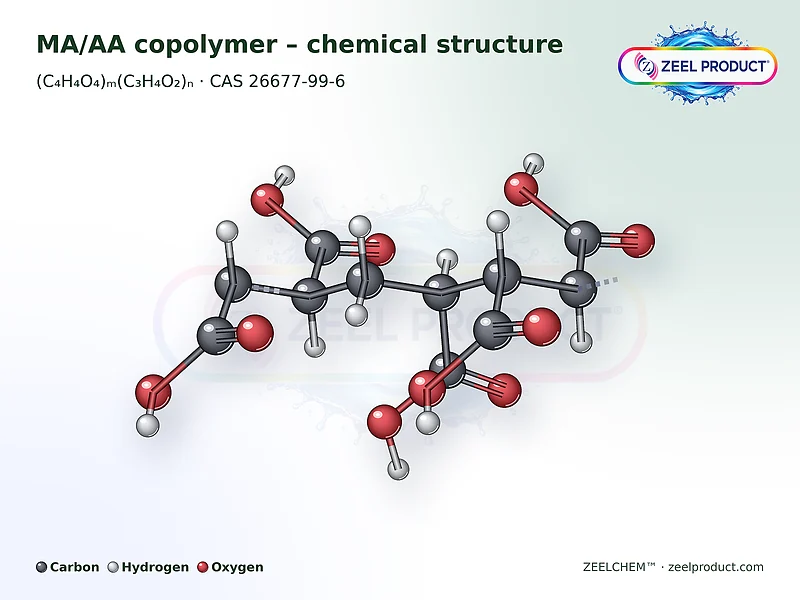
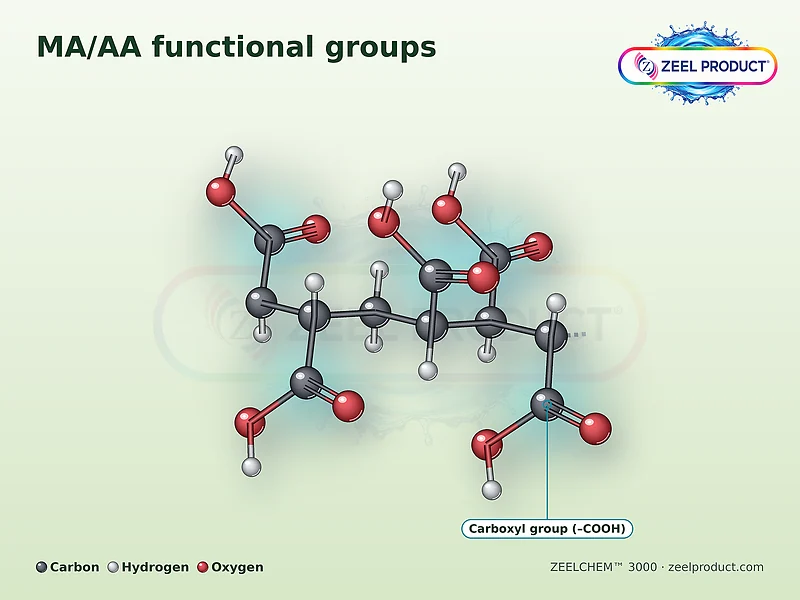
MA/AA is a random copolymer of maleic acid (two carboxyls per unit) and acrylic acid (one carboxyl per unit). Its molecular weight (about 3,000–5,000 for the acid form) sits between HPMA and PAA. The result is a polymer with high charge density and a backbone long enough to disperse.
Typical specifications – ZEELCHEM™ 3000
| Parameter | Value |
|---|---|
| Solid content | ≥ 48 % |
| Free monomer (as MA) | ≤ 1.0 % |
| pH (1 %) | 2.0 – 3.0 |
| Density | ≥ 1.18 g/cm³ |
| Mw | 3,000 – 5,000 |
Where MA/AA shines
- High hardness and alkalinity: it resists precipitation with calcium (see calcium tolerance explained).
- Alkaline (no-acid) cooling programs at pH 8.5–9.2. See the alkaline program guide.
- Detergents: as the sodium salt, a phosphate-free co-builder. See MA/AA in detergents.
- Boilers and evaporators with good thermal stability.
Dosage summary
| Use | Dose |
|---|---|
| Cooling tower | 2 – 15 mg/L |
| Blend with phosphonate | 20 – 40 % of formulation |
| Boiler | 3 – 10 mg/L |
| Detergent | 1 – 5 % |
How it compares
Against PAA, MA/AA is stronger in hard, alkaline water. Against HPMA, it disperses better and costs less per active. For calcium phosphate and zinc, move up to AA/AMPS or terpolymer.
Product details and price: ZEELCHEM™ 3000 MA/AA copolymer.
 FEATURED PRODUCT
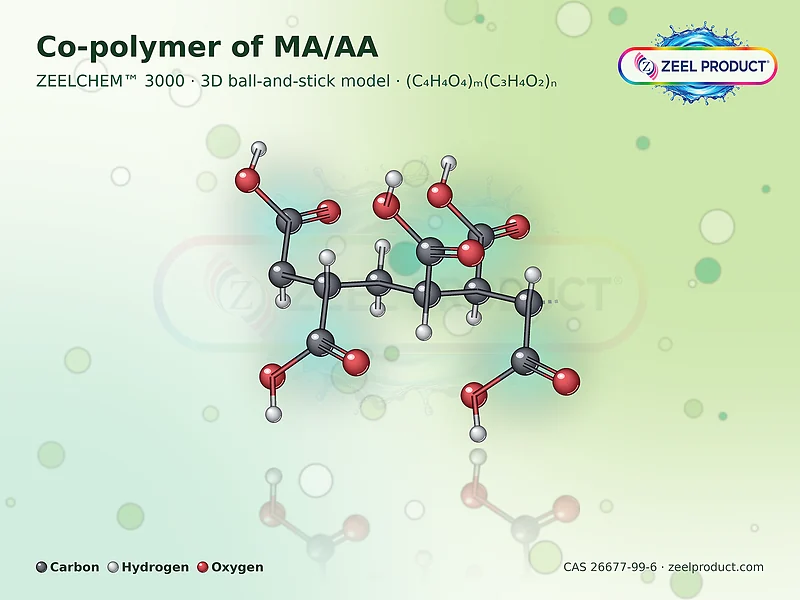
ZEELCHEM™ 3000 – Co-polymer of MA/AA
Maleic–acrylic copolymer for high-hardness, high-alkalinity water: calcium carbonate inhibition plus dispersion.
FAQ
What is the CAS number of MA/AA copolymer?
26677-99-6 for the acid form; the sodium salt is 52255-49-9.
Is MA/AA biodegradable?
Like other polycarboxylates, it is not readily biodegradable, but it has low toxicity and is removed by adsorption on sludge.
Can MA/AA replace HPMA?
In many cooling and boiler applications, yes, with better dispersion. At very high temperature, HPMA remains stronger.
More from ZEEL PRODUCT: zeelproduct.com · zeelproduct.net · ZEELCHEM™ range · online shop · zeelproductonline.co.in