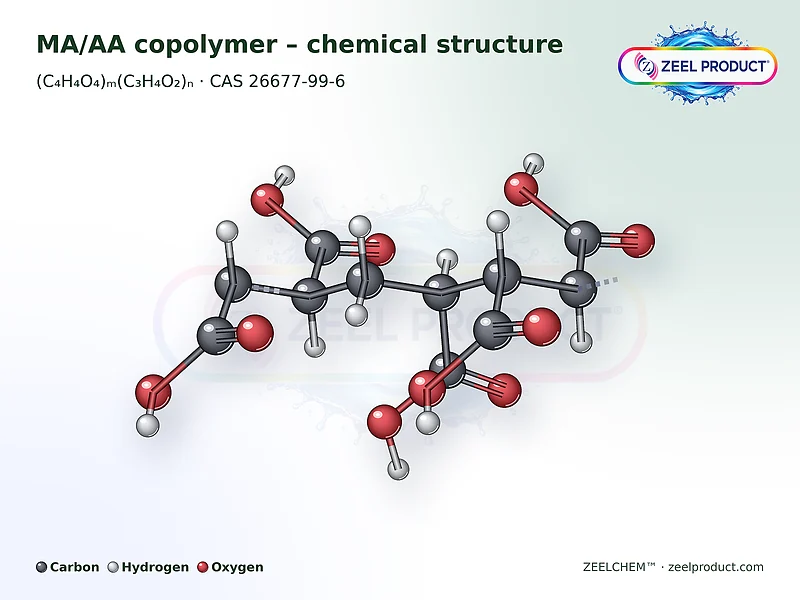
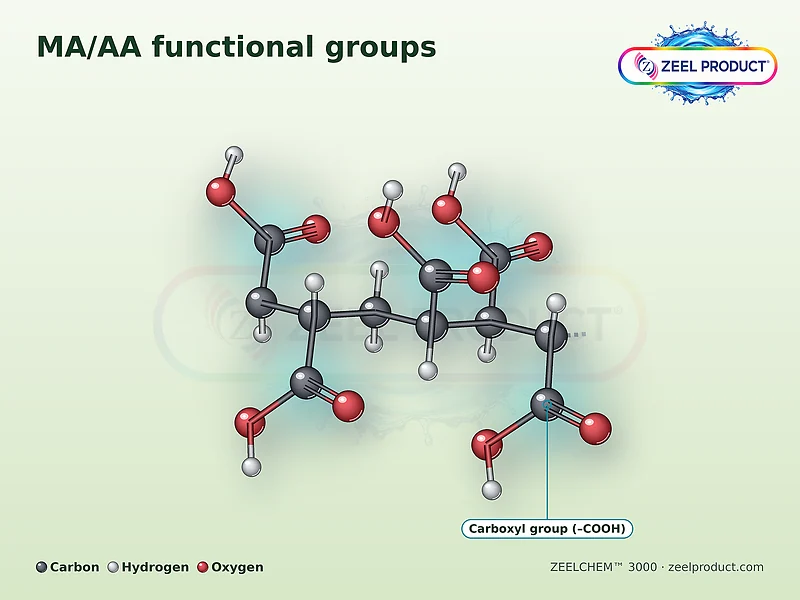
Quick answer: An alkaline cooling program lets the tower run at its natural pH (8.5–9.2) without sulphuric acid. It relies on a strong polymer–phosphonate blend, for example MA/AA (ZEELCHEM™ 3000) with PBTC or HEDP, to hold calcium carbonate in solution up to an LSI of about 2.5–3.0. This removes acid-handling hazards and lowers corrosion rates.
Why go alkaline?
- Safety: no concentrated sulphuric acid storage or handling.
- Lower corrosion: steel corrodes more slowly at pH 8.5–9 than at pH 7.
- No risk of acid overfeed damaging equipment.
- Simpler control: fewer chemicals and pumps.
The limit: calcium carbonate
At high pH and cycles, calcium carbonate supersaturation rises quickly. The program works only if the inhibitor can hold the LSI within its capability. Typical safe limits are:
| Program strength | Max LSI | Typical components |
|---|---|---|
| Standard | ~2.0 | HEDP + PAA |
| Alkaline | ~2.5 | PBTC/HEDP + MA/AA |
| High-stress alkaline | ~3.0 | PBTC + MA/AA + terpolymer |
Program design
- Analyse make-up water: Ca, M-alkalinity, Mg, silica, chloride, sulphate.
- Calculate LSI at target cycles and skin temperature (the hottest exchanger).
- Choose cycles so that LSI stays within the program limit.
- Select the blend: MA/AA for carbonate, plus AA/AMPS if iron or silica is present.
- Add azole for copper and a biocide program (oxidising + non-oxidising).
Monitoring
- Calcium balance: (basin Ca ÷ make-up Ca) should match conductivity-based cycles within about 10 %.
- Corrosion coupons: mild steel < 3 mpy, copper < 0.2 mpy as typical targets.
- Heat exchanger approach temperatures and visual inspection.
Use the dosage calculator to estimate consumption at your target cycles. For water-saving strategies, read running high cycles.
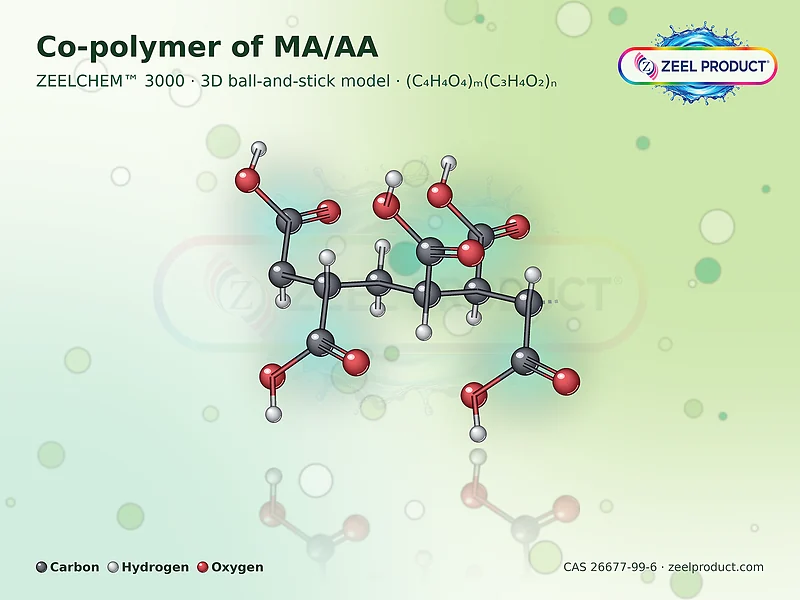 FEATURED PRODUCT
ZEELCHEM™ 3000 – Co-polymer of MA/AA
Maleic–acrylic copolymer for high-hardness, high-alkalinity water: calcium carbonate inhibition plus dispersion.
FAQ
What pH does an alkaline cooling program run at?
Typically 8.5–9.2, the natural equilibrium pH at the chosen cycles.
Is corrosion higher without acid?
Usually lower for mild steel, because corrosion rates fall as pH rises.
What if LSI goes too high?
Reduce cycles, use a stronger blend, or add limited acid feed for pH trimming.
More from ZEEL PRODUCT: zeelproduct.com · zeelproduct.net · ZEELCHEM™ range · online shop · zeelproductonline.co.in