Why molecular weight matters
A polyacrylate chain with 30 repeat units and one with 30,000 repeat units have the same chemistry but behave completely differently in water. Short chains adsorb on a single crystal nucleus or particle and charge it, which produces dispersion. Long chains reach across several particles and tie them together, which produces flocculation. Very long chains also tangle and raise viscosity, which is thickening.
Molecular weight ranges and functions
| Mw range (Da) | Main function | Typical use |
|---|---|---|
| 1,000 – 5,000 | Threshold scale inhibition, dispersion | Cooling, boiler, RO, detergents (ZEELCHEM™ 1000) |
| 5,000 – 20,000 | Strong dispersion, some scale inhibition | Pigment and mineral slurries, iron dispersion |
| 50,000 – 500,000 | Binding, film forming, partial flocculation | Coatings, adhesives |
| > 1,000,000 | Thickening, flocculation, super-absorbency (cross-linked) | Thickeners, SAP |
The optimum for scale inhibition
Published studies and field experience agree that calcium carbonate and calcium sulphate inhibition peaks at roughly 2,000–5,000 Da for polyacrylates. Below this, chains are too short to stay adsorbed. Above it, the polymer starts to bridge particles and is more easily precipitated by calcium. This is why ZEELCHEM™ 1000 is targeted at an Mw of 1,800–5,000.
How to read molecular weight on a TDS
- Mw (weight average) is the figure usually quoted, measured by GPC.
- Polydispersity (Mw/Mn) shows how broad the distribution is. Narrower is generally more consistent.
- Viscosity at fixed solids gives a quick indirect check: higher viscosity usually means higher MW.
Picking the right grade
For cooling, boiler and RO scale control choose low-MW PAA or its copolymers (MA/AA, AA/AMPS). For slurries and ceramics, a low-MW sodium salt such as ZEELCHEM™ 1000.S7 is usually preferred. Do not substitute a high-MW flocculant grade in a cooling tower: it can bind solids and increase fouling. Our polymer selection guide compares all options.
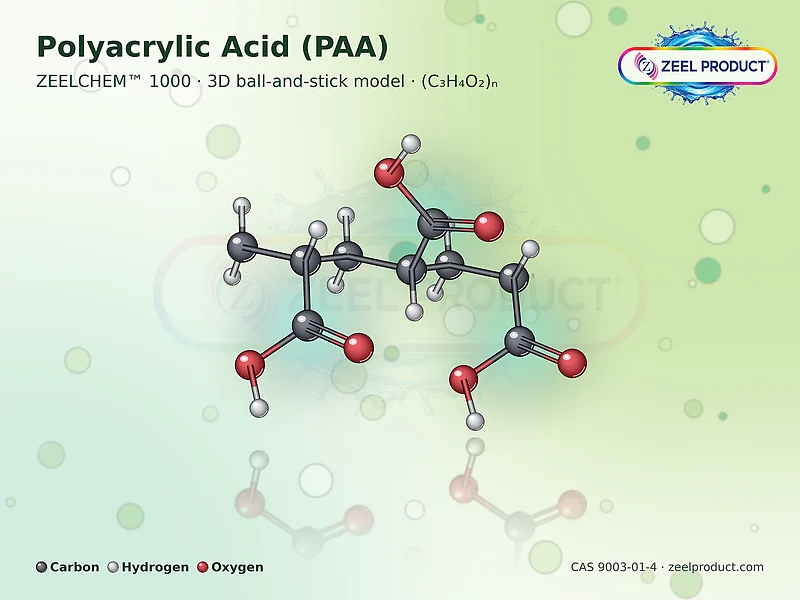 FEATURED PRODUCT
ZEELCHEM™ 1000 – Polyacrylic Acid
Low molecular weight polyacrylic acid for calcium carbonate scale inhibition and dispersion in cooling, boiler and RO water.
FAQ
What molecular weight PAA is best for scale inhibition?
Roughly 2,000–5,000 Da for calcium carbonate and sulphate inhibition.
Can high molecular weight PAA be used as an antiscalant?
No. High-MW grades tend to flocculate and are easily precipitated by calcium, so they are unsuitable as antiscalants.
How is molecular weight measured?
By gel permeation chromatography (GPC), which gives Mw, Mn and polydispersity.
More from ZEEL PRODUCT: zeelproduct.com · zeelproduct.net · ZEELCHEM™ range · online shop · zeelproductonline.co.in