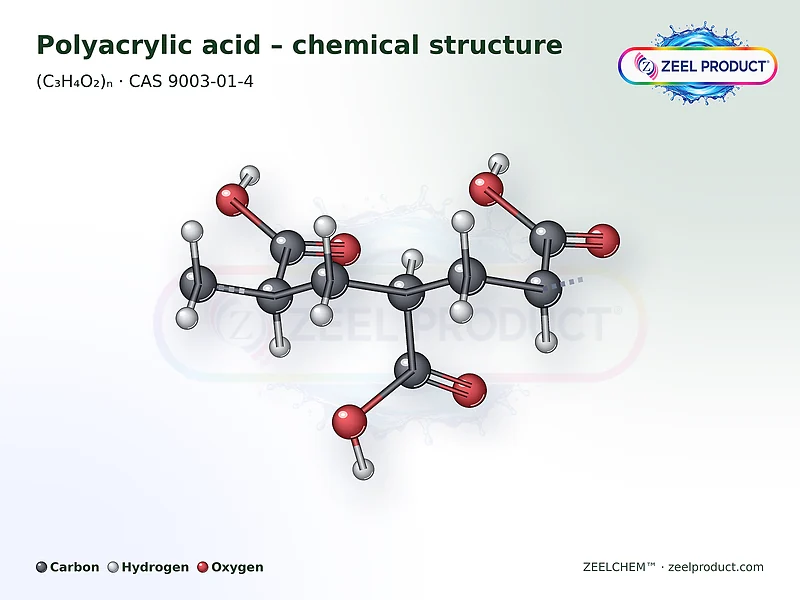
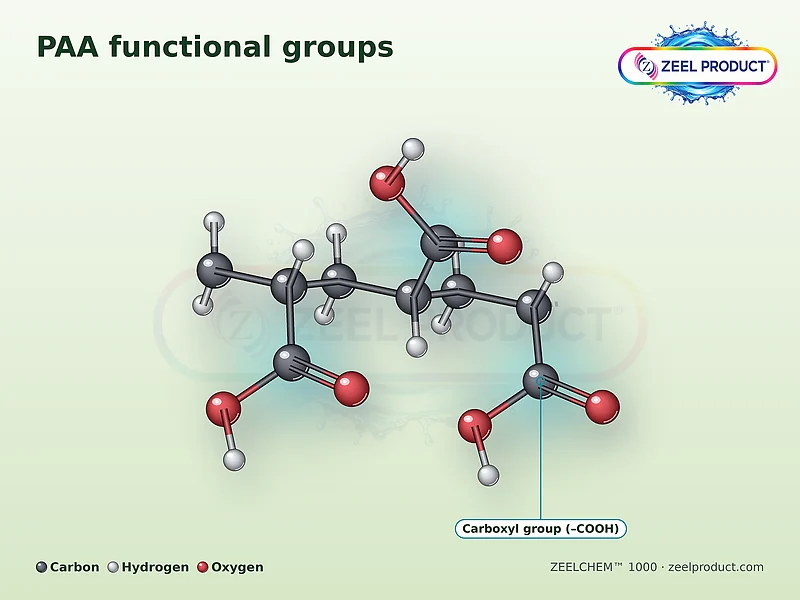
Same polymer, two forms
Neutralise polyacrylic acid with caustic soda and you get sodium polyacrylate. The backbone stays the same; only the counter-ion on the carboxyl groups changes, from H⁺ to Na⁺. In use, both end up largely ionised at the pH of cooling water (7.5–9), so their scale-inhibiting action is very similar.
Side-by-side comparison
| Property | ZEELCHEM™ 1000 (PAA) | ZEELCHEM™ 1000.S7 (Na-PA) |
|---|---|---|
| pH (1 %) | 2.0 – 3.0 | 6.0 – 8.0 |
| Solid content | ≥ 48 % | 40 – 45 % |
| Handling hazard | Acidic, eye/skin irritant | Low, near-neutral |
| Metal compatibility (neat) | Corrosive to MS, Cu, Al | Compatible with most metals |
| Blending with HEDP/ATMP | Excellent, no neutralisation needed | Possible, but watch the pH shift |
| Best for | Cooling/boiler formulations, RO blends | Ceramics, slurries, detergents, direct dosing |
When to choose the acid form
- You formulate cooling water or RO antiscalant blends with acidic phosphonates (HEDP, ATMP, PBTC from the ZEELCHEM™ range).
- You want the highest active content per kg for freight economy.
- The formulation's final pH is acidic anyway.
When to choose the sodium salt
- You dose neat into neutral process water and want to avoid a local pH drop.
- Operators handle the product manually and safety is a priority.
- You make detergents, ceramic slips, CaCO₃/kaolin slurries or paper coatings. See the sodium polyacrylate guide.
Cost comparison on an active basis
Always compare price per kg of active polymer: price ÷ solids fraction. Remember that the sodium salt's solids include sodium, so its polymer-acid equivalent is a little lower than the solids figure suggests. For most cooling water uses, equal doses of active polymer give similar results.
Explore both products: ZEELCHEM™ 1000 polyacrylic acid and ZEELCHEM™ 1000.S7 sodium polyacrylate.
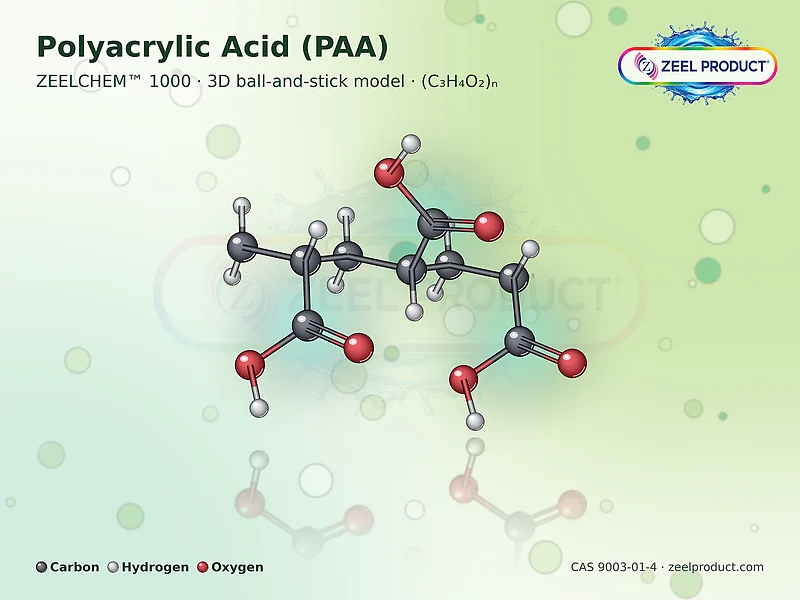 FEATURED PRODUCT
ZEELCHEM™ 1000 – Polyacrylic Acid
Low molecular weight polyacrylic acid for calcium carbonate scale inhibition and dispersion in cooling, boiler and RO water.
FAQ
Can I neutralise PAA myself?
Yes, with caustic soda under controlled conditions, but the reaction is exothermic. Buying ready sodium polyacrylate is safer and more consistent.
Is sodium polyacrylate liquid the same as SAP powder?
No. SAP is cross-linked and very high MW. ZEELCHEM™ 1000.S7 is a low-MW soluble dispersant.
Which is better for a cooling tower?
Both work. The acid form is preferred in blended formulations; the salt where neutral dosing is required.
More from ZEEL PRODUCT: zeelproduct.com · zeelproduct.net · ZEELCHEM™ range · online shop · zeelproductonline.co.in