What is polyacrylic acid?
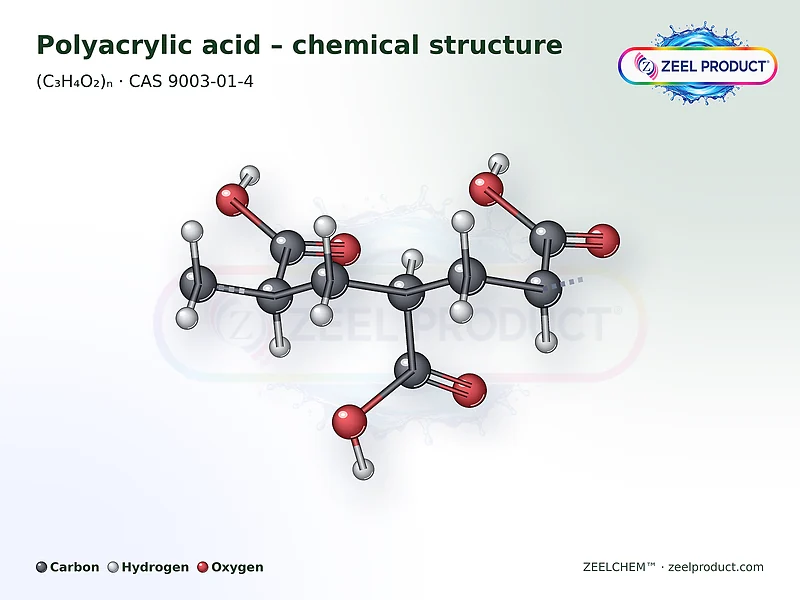
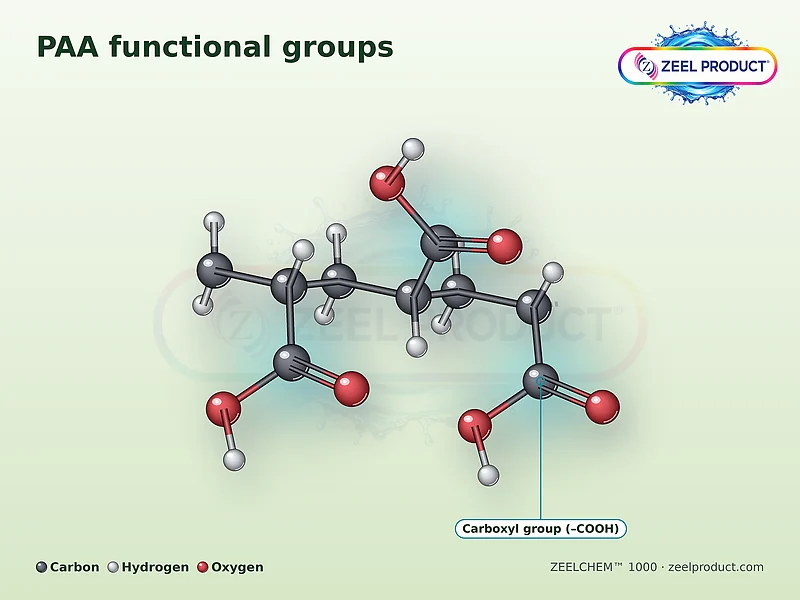
Polyacrylic acid is a synthetic polymer made by free-radical polymerisation of acrylic acid (CH₂=CH–COOH). Each repeat unit carries one carboxylic acid group. In water these groups partly ionise to carboxylate (–COO⁻), so the chain behaves as a polyelectrolyte: a long molecule with many negative charges.
Molecular weight decides what PAA does. Very high molecular weight grades (millions of Daltons) are thickeners and flocculants. Low molecular weight grades of roughly 1,000–10,000 Da are scale inhibitors and dispersants. ZEELCHEM™ 1000 belongs to this low-MW family, with a typical Mw of 1,800–5,000 and ≥ 48 % solids.
How PAA stops scale
When water evaporates in a cooling tower or heats up in a boiler, calcium and carbonate ions become supersaturated. Without treatment they crystallise as calcite on the hottest surfaces. PAA interferes in three ways:
- Threshold effect: a few mg/L of polymer adsorbs on microscopic nuclei and stops them from growing. This is far less than the amount needed to chelate calcium.
- Crystal distortion: crystals that do form are irregular and brittle, and flow removes them easily.
- Dispersion: the negative charge spreads onto clay, silt and corrosion products, keeping them suspended until blowdown removes them.
Main uses of polyacrylic acid
| Industry | Role of PAA |
|---|---|
| Cooling towers | CaCO₃ inhibitor and dispersant; base polymer in phosphonate blends |
| Boilers | Sludge conditioner in internal treatment |
| RO plants | Polymer part of antiscalant formulations |
| Detergents | Anti-redeposition and anti-encrustation |
| Textiles | Sequestering/dispersing aid in wet processing |
| Minerals & ceramics | Grinding aid and slurry dispersant (usually as the sodium salt) |
Typical dosage
In an open cooling tower, PAA used alone is typically maintained at 5–15 mg/L as product in the recirculating water. In a blended program with HEDP or PBTC, the polymer is usually 20–40 % of the formulation, and the blend is dosed at 30–100 mg/L. Use our dosage calculator to convert mg/L into kg/day, and read the detailed PAA dosage guide.
Limitations to know
PAA is not a strong inhibitor of calcium phosphate, and it can lose efficiency in very hard, high-pH water where calcium–polymer salts precipitate. For those conditions choose a sulphonated polymer such as AA/AMPS (ZEELCHEM™ 3100) or a terpolymer (ZEELCHEM™ 7000). At high temperature, HPMA (ZEELCHEM™ 200) is the better option.
Choosing a PAA supplier
Compare suppliers on solid content, free monomer, molecular weight and batch consistency, not on price per kg alone. A 40 % product at a lower price can cost more per mg/L of active polymer than a 48 % product. ZEEL PRODUCT supplies every batch with a COA and dispatches across India from Vadodara. See the PAA price buying guide for a cost-per-active calculation.
 FEATURED PRODUCT
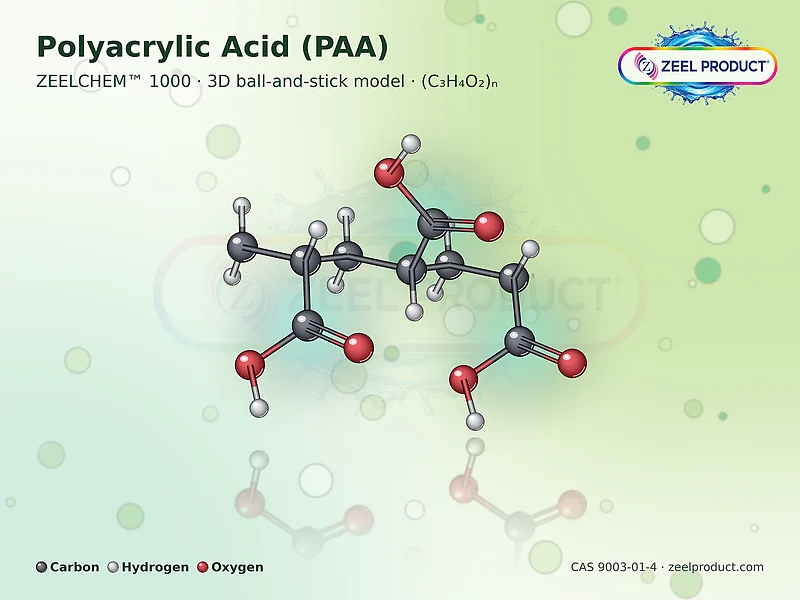
ZEELCHEM™ 1000 – Polyacrylic Acid
Low molecular weight polyacrylic acid for calcium carbonate scale inhibition and dispersion in cooling, boiler and RO water.
FAQ
Is polyacrylic acid toxic?
Low molecular weight PAA has low toxicity and is widely used in water treatment and detergents. The acid form is an eye and skin irritant, so use goggles and gloves when handling it.
What is the CAS number of polyacrylic acid?
CAS 9003-01-4.
Does PAA contain phosphorus?
No. PAA is phosphorus-free, which helps plants meet phosphate discharge limits.
More from ZEEL PRODUCT: zeelproduct.com · zeelproduct.net · ZEELCHEM™ range · online shop · zeelproductonline.co.in