Why dosage is based on blowdown
In an open recirculating cooling tower, water leaves as pure vapour through evaporation, but polymer leaves only with blowdown (and a little drift). To keep a constant polymer level, you therefore replace what blowdown removes. The higher the cycles of concentration, the lower the blowdown, so a high-cycle system uses less product.
The four formulas you need
- Evaporation E (m³/h) = 0.00153 × R × ΔT, where R is the recirculation rate in m³/h and ΔT is the range in °C.
- Blowdown B (m³/h) = E ÷ (COC − 1).
- Make-up M = E + B.
- Product demand (kg/day) = B × 24 × dose (mg/L) ÷ 1000.
Worked example
| Input | Value |
|---|---|
| Recirculation rate | 500 m³/h |
| ΔT | 6 °C |
| Cycles of concentration | 4 |
| System volume | 300 m³ |
| ZEELCHEM™ 1000 dose | 10 mg/L as product |
E = 0.00153 × 500 × 6 = 4.59 m³/h, or 110 m³/day. B = 110 ÷ 3 = 36.7 m³/day. Daily product = 36.7 × 10 ÷ 1000 = 0.37 kg/day, about 11 kg a month. The initial shot to bring 300 m³ to 10 mg/L is 300 × 10 ÷ 1000 = 3 kg.
You can repeat this instantly with your own data in the free cooling tower dosage calculator.
How to choose the dose set-point
- Low hardness, LSI below 1.5: 5–8 mg/L.
- Moderate hardness, LSI 1.5–2.5: 8–12 mg/L, ideally combined with a phosphonate.
- High hardness or high pH, LSI above 2.5: switch to MA/AA or blend PAA with HEDP/PBTC. See LSI explained.
- Heavy silt or iron: add or switch to AA/AMPS for dispersion.
Feeding and monitoring
Dose continuously with a diaphragm pump into the tower basin or the make-up line, ideally paced to make-up flow. Check polymer residual (with an inert tracer or a polymer test kit), calcium and alkalinity in make-up and in the basin, and conductivity-based COC weekly. If calcium in the basin is noticeably lower than make-up calcium × COC, scale is forming and the dose or program needs review.
Tip: For new systems, pre-clean and passivate first, then start the maintenance dose. Dosing polymer onto existing scale only slows further growth. It does not remove old deposits quickly.
 FEATURED PRODUCT
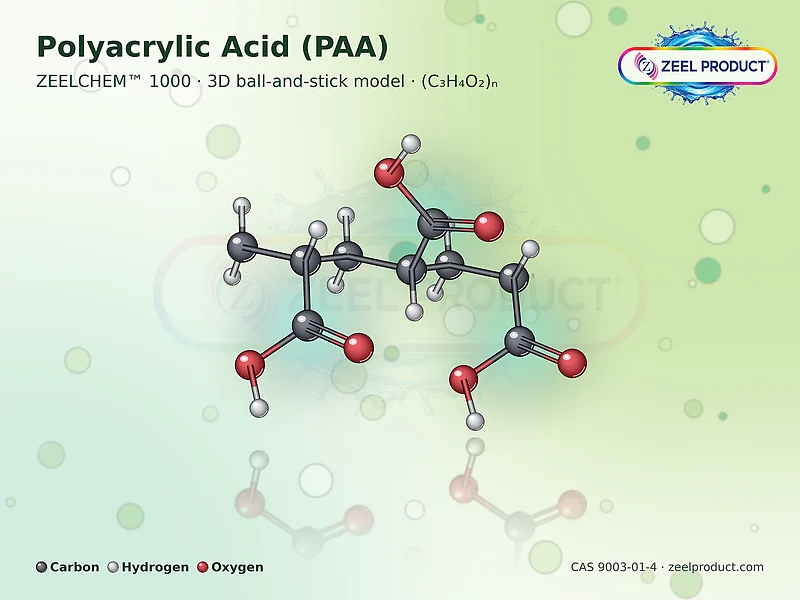
ZEELCHEM™ 1000 – Polyacrylic Acid
Low molecular weight polyacrylic acid for calcium carbonate scale inhibition and dispersion in cooling, boiler and RO water.
FAQ
How many ppm of polyacrylic acid is used in cooling water?
Typically 5–15 ppm (mg/L) as product, depending on hardness, alkalinity, temperature and cycles of concentration.
Should PAA be dosed in the make-up or the basin?
Either works. Dosing into the basin near the pump suction, or paced to make-up flow, gives a steady residual.
Why is my polymer consumption higher than calculated?
Uncontrolled leaks, high drift, filter backwash, or an inaccurate blowdown meter all add hidden blowdown.
More from ZEEL PRODUCT: zeelproduct.com · zeelproduct.net · ZEELCHEM™ range · online shop · zeelproductonline.co.in