Why deflocculation matters
Ceramic bodies contain clay platelets with charged edges and faces that attract each other, forming a gel-like "card-house". This raises slip viscosity, so more water is needed to make it flow. In a tile plant, every extra percent of water must be evaporated in the spray dryer, which costs fuel.
How sodium polyacrylate works
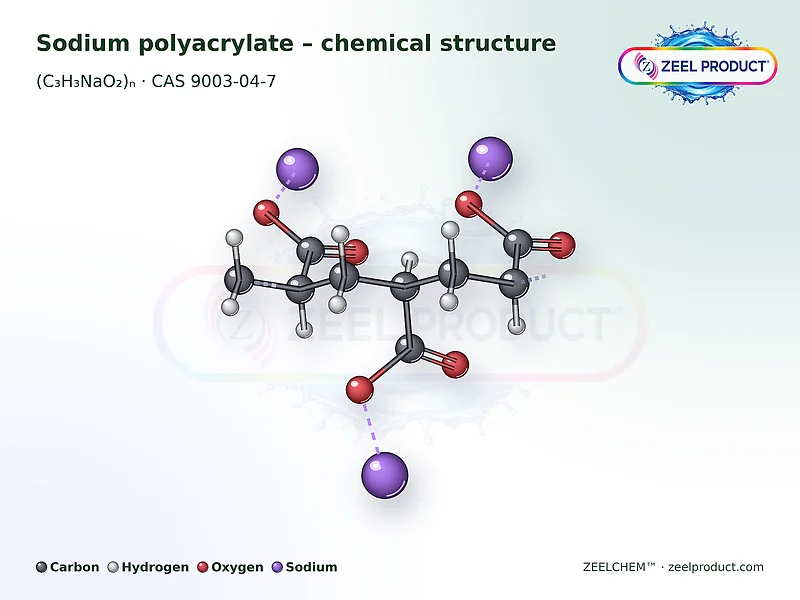
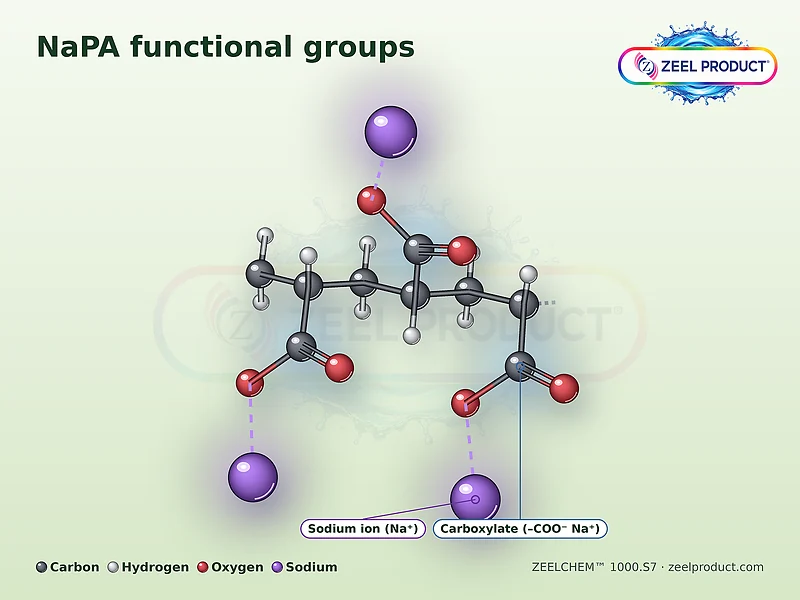
The polymer adsorbs on clay edges and reverses their charge to negative. All particles then repel each other, the card-house collapses and the slip flows freely at much higher solids.
The deflocculation curve
Viscosity falls as deflocculant is added, reaches a minimum, then rises again when overdosed. Plot viscosity (or flow-cup time) against dose to find the optimum.
| Dose (% on dry body) | Flow time (example) |
|---|---|
| 0.0 | Does not flow |
| 0.2 | 85 s |
| 0.4 | 42 s |
| 0.6 | 36 s (optimum) |
| 0.8 | 40 s (overdose) |
Illustrative values; run the curve on your own body and water.
Polyacrylate vs silicate vs STPP
| Deflocculant | Strength | Notes |
|---|---|---|
| Sodium silicate | Low cost | High doses, can raise green-body brittleness |
| STPP | Effective | Phosphate; can hydrolyse in storage |
| Sodium polyacrylate | Very effective at low dose | Stable, consistent, phosphate-free |
Many plants use a blend, for example silicate plus 0.1–0.3 % polyacrylate, to balance cost and performance.
Plant tips
- Add the deflocculant to the water before the clay charge in ball mills.
- Hard water reduces efficiency, so check water hardness.
- Measure density and flow time on every batch.
- Glaze slips: 0.1–0.3 % is usually enough.
ZEEL PRODUCT supplies ZEELCHEM™ 1000.S7 to ceramic clusters in Morbi, Thangadh and Wankaner in Gujarat, and Khurja in Uttar Pradesh, and to plants across India. See delivery network.
 FEATURED PRODUCT
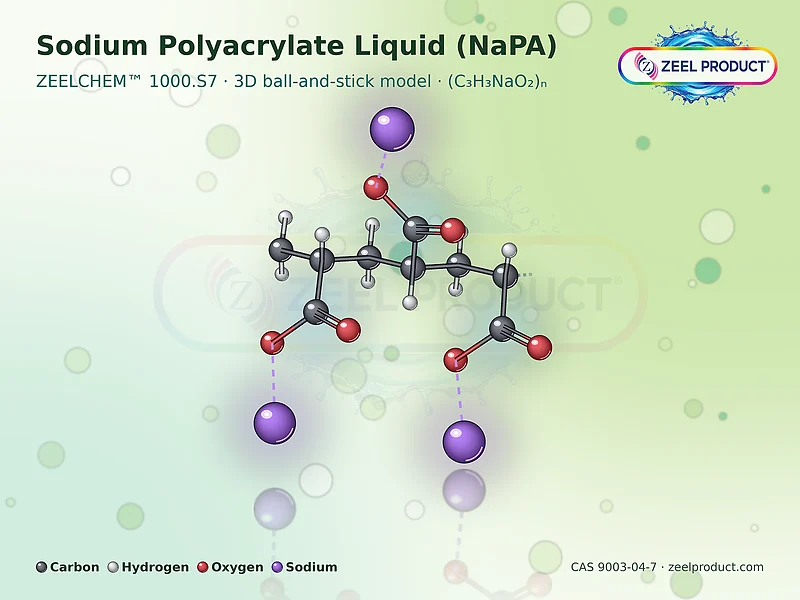
ZEELCHEM™ 1000.S7 – Sodium Polyacrylate Liquid
Neutral-pH sodium polyacrylate dispersant for water treatment, ceramics, pigments, paper, detergents and mineral slurries.
FAQ
How much deflocculant for ceramic slip?
Typically 0.2–0.8 % sodium polyacrylate on dry body, set by a deflocculation curve.
Can sodium polyacrylate replace sodium silicate?
Fully or partly. Blends are common for cost balance.
Why does viscosity rise after a certain dose?
Overdosing compresses the electrical double layer and adds free polymer, which re-thickens the slip.
More from ZEEL PRODUCT: zeelproduct.com · zeelproduct.net · ZEELCHEM™ range · online shop · zeelproductonline.co.in