Where oilfield scale forms
- Production tubing and chokes: pressure drop releases CO₂ and raises pH, so CaCO₃ precipitates.
- Mixing of incompatible waters: seawater sulphate meets formation-water barium or strontium and forms BaSO₄/SrSO₄.
- Heater treaters and dehydration: heating produced water forms carbonate scale.
- Injection lines and filters: carbonate and iron deposits.
Why HPMA
HPMA stays active at high temperature and in high-TDS brines and is strong against CaCO₃ and CaSO₄. For barium/strontium sulphate, phosphonates such as DTPMP or sulphonated polymers are usually added. See AA/AMPS.
Typical dosing
| Application | Dose | Method |
|---|---|---|
| Injection water | 5 – 15 mg/L | Continuous injection |
| Produced water / surface facilities | 10 – 30 mg/L | Continuous, upstream of the heater |
| Downhole (squeeze) | Program-specific | Usually phosphonate-based squeeze |
Selecting the dose
Use scaling-tendency software and laboratory static jar and dynamic tube-blocking tests on field brines to find the minimum inhibitor concentration (MIC). Then add a safety margin and confirm by monitoring residuals and ion balance. Our jar test guide explains the basics.
Compatibility
Check compatibility with corrosion inhibitors, demulsifiers and high-calcium brines, because some inhibitors precipitate with calcium at high concentration. HPMA has good calcium tolerance. Blends with MA/AA add dispersion of fines and iron sulphide.
 FEATURED PRODUCT
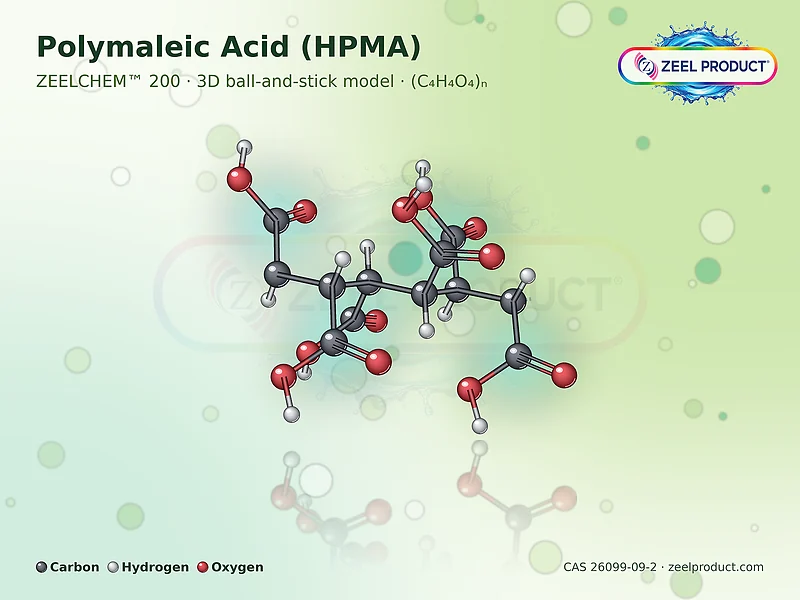
ZEELCHEM™ 200 – Polymaleic Acid (HPMA)
High-temperature scale inhibitor for boilers, evaporators, desalination and high-alkalinity water, effective up to 300 °C.
FAQ
Does HPMA control barium sulphate?
Only partly. BaSO₄ usually needs phosphonate (e.g. DTPMP) or sulphonated polymer inhibitors.
Is HPMA stable in high salinity brines?
Yes. It tolerates high TDS and calcium.
How is MIC determined?
By static and dynamic scale tests on actual field brines.
More from ZEEL PRODUCT: zeelproduct.com · zeelproduct.net · ZEELCHEM™ range · online shop · zeelproductonline.co.in