Chemistry of HPMA
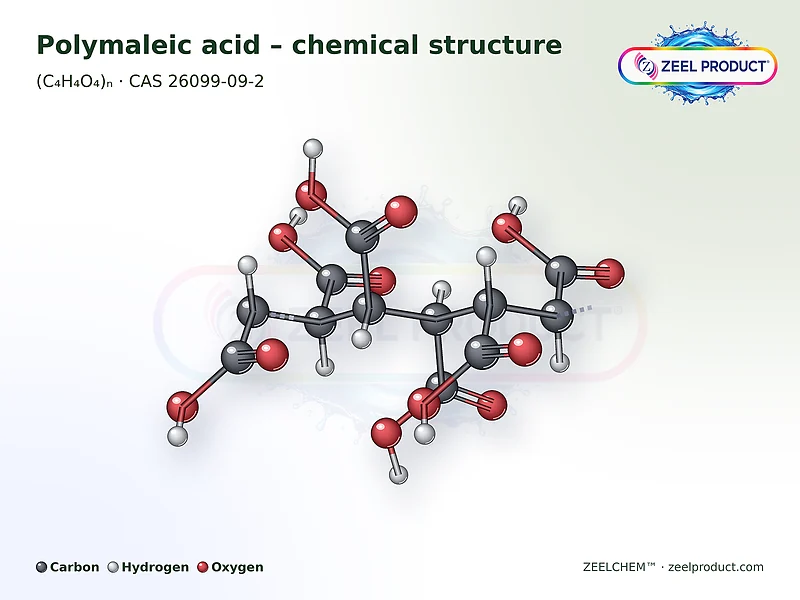
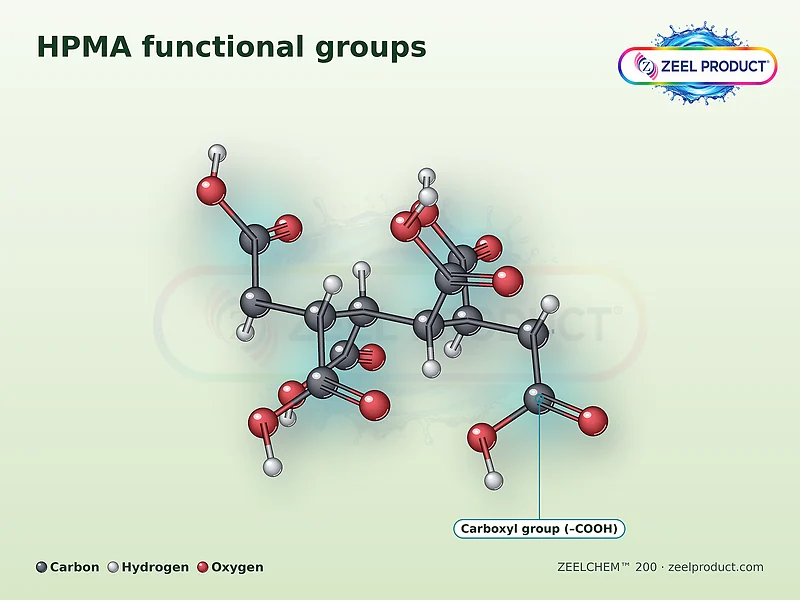
HPMA is made by polymerising maleic anhydride, usually in water or a solvent, and then hydrolysing the anhydride rings to maleic acid units. Each unit has two adjacent carboxyl groups, so the charge density is about twice that of polyacrylic acid. The chains are short, typically 4–8 repeat units.
Key properties
| Property | ZEELCHEM™ 200 typical |
|---|---|
| Solid content | ≥ 48 % |
| Bromine value | ≤ 80 mg/g |
| pH (1 %) | 2.0 – 3.0 |
| Density | ≥ 1.18 g/cm³ |
| Molecular weight | 400 – 800 |
| Thermal limit | ~300 °C |
The bromine value measures residual double bonds from unreacted maleic units. A low value indicates complete polymerisation and stable, consistent performance.
Why HPMA works at high temperature
Most polymers lose threshold efficiency as temperature rises, because calcium carbonate supersaturation rises steeply and polymer adsorption weakens. HPMA's dense carboxylate clusters bind Ca²⁺ sites on calcite very strongly, and its backbone resists thermal breakdown. It therefore stays effective in boiler water, brine heaters and evaporator tubes. Read more in HPMA for boilers and HPMA in desalination.
Applications and doses
- Low/medium pressure boilers: 2–8 mg/L in feed water.
- Alkaline cooling towers (no acid): 3–12 mg/L.
- MSF/MED desalination: 2–6 mg/L.
- Sugar evaporators: 3–10 mg/L on juice. See sugar evaporator guide.
- Oilfield water: 5–30 mg/L. See oilfield guide.
Limitations
Because its molecules are small, HPMA is a weak dispersant for silt and iron, and it does little for calcium phosphate. Pair it with AA/AMPS or PAA when those are present, or use MA/AA, which combines maleic and acrylic properties.
Product page: ZEELCHEM™ 200 HPMA – specifications and price.
 FEATURED PRODUCT
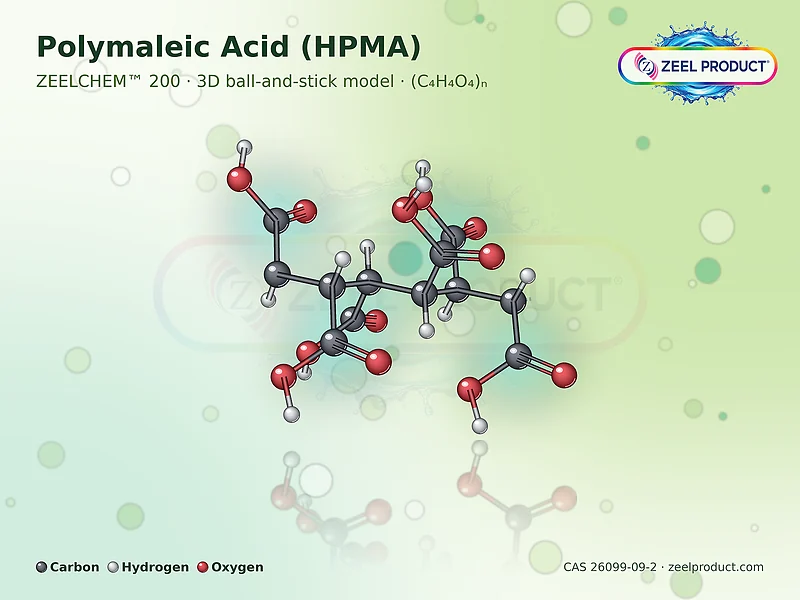
ZEELCHEM™ 200 – Polymaleic Acid (HPMA)
High-temperature scale inhibitor for boilers, evaporators, desalination and high-alkalinity water, effective up to 300 °C.
FAQ
Is HPMA the same as polymaleic acid?
Yes. HPMA is hydrolysed polymaleic anhydride, commonly called polymaleic acid.
What is the CAS number of HPMA?
CAS 26099-09-2.
Is HPMA phosphorus-free?
Yes. It contains no phosphorus.
More from ZEEL PRODUCT: zeelproduct.com · zeelproduct.net · ZEELCHEM™ range · online shop · zeelproductonline.co.in