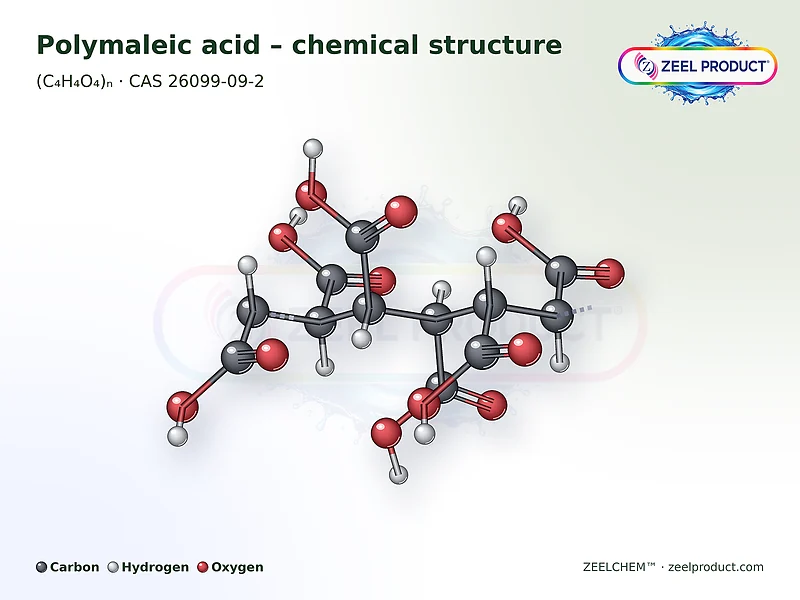
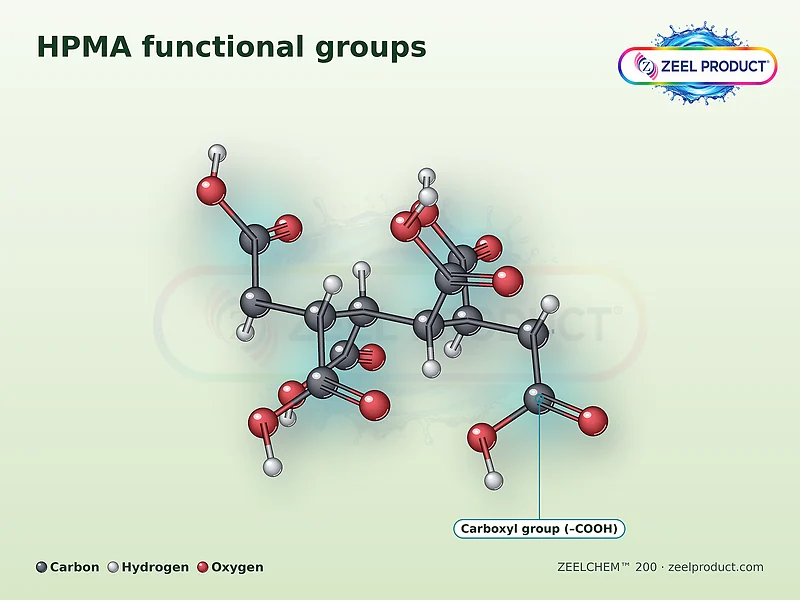
Quick answer: Choose HPMA (ZEELCHEM™ 200) for high temperature, high pH and high alkalinity: boilers, evaporators, desalination and non-acid cooling. Choose PAA (ZEELCHEM™ 1000) for normal cooling tower conditions where dispersion and cost-effectiveness matter more. Many formulations use both together.
Head-to-head comparison
| Factor | HPMA – ZEELCHEM™ 200 | PAA – ZEELCHEM™ 1000 |
|---|---|---|
| Carboxyl groups per unit | 2 | 1 |
| Molecular weight | 400 – 800 | 1,800 – 5,000 |
| CaCO₃ inhibition at > 80 °C | Excellent | Good |
| Performance at pH > 8.8 | Excellent | Moderate |
| Dispersion of silt and iron | Weak | Good |
| Calcium sulphate | Very good | Good |
| Relative cost per active | Higher | Lower |
| Typical colour | Light yellow–amber | Colourless–light yellow |
Pick HPMA when…
- Temperatures are high: boilers, evaporators, thermal desalination.
- You run an alkaline cooling program without acid and the pH is 8.8–9.2.
- Gypsum (CaSO₄) scale is a risk.
Pick PAA when…
- The cooling tower is at moderate pH and temperature.
- Suspended solids, mud or iron need dispersion.
- Cost per kg active is the main driver.
Or use both
A common cooling water blend uses HPMA for threshold strength and PAA for dispersion, for example in a 1:1 ratio alongside HEDP. The balanced alternative in a single product is MA/AA copolymer. See MA/AA vs HPMA.
Compare all six polymers on the products page or run the polymer selector.
 FEATURED PRODUCT
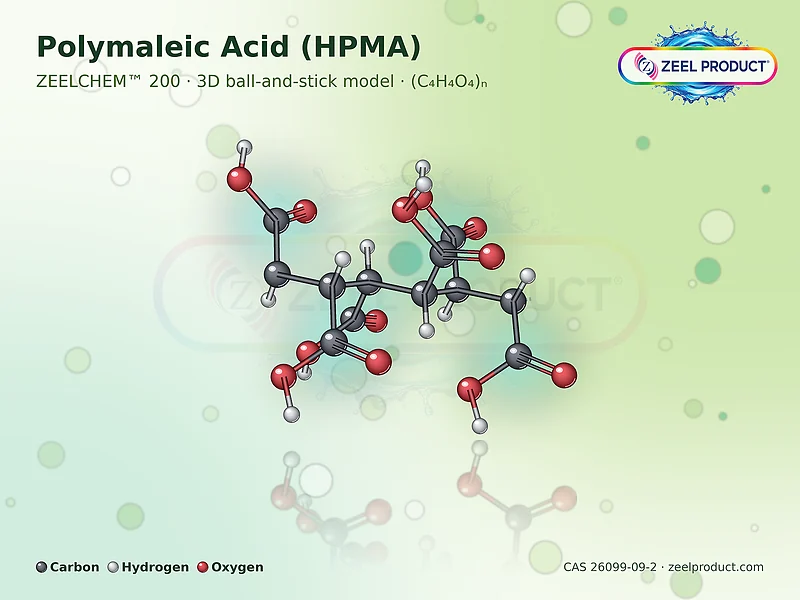
ZEELCHEM™ 200 – Polymaleic Acid (HPMA)
High-temperature scale inhibitor for boilers, evaporators, desalination and high-alkalinity water, effective up to 300 °C.
FAQ
Is HPMA stronger than PAA?
At high temperature and pH, yes. At normal cooling conditions both work, and PAA disperses better.
Can HPMA and PAA be mixed?
Yes. They are fully compatible and often blended.
Which is cheaper?
PAA is usually cheaper per kg of active polymer.
More from ZEEL PRODUCT: zeelproduct.com · zeelproduct.net · ZEELCHEM™ range · online shop · zeelproductonline.co.in