 By ZEELCHEM Technical Team · ZEEL PRODUCT, Vadodara
Published · Updated · 3 min read
Quick answer
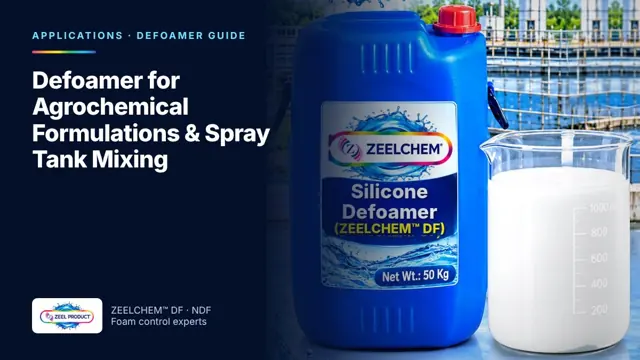
Pesticide and fertiliser formulations contain wetting agents and dispersants that foam during milling, mixing, packing and when farmers fill spray tanks. Silicone antifoam emulsions and powders are widely used in suspension concentrates (SC), soluble liquids (SL), emulsions (EW), water-dispersible granules (WG) and wettable powders (WP), and as tank-mix additives.
Where foam hurts agrochemicals
- Bead milling of SC formulations — air leads to poor milling and wrong density.
- Filling and packing — inaccurate volumes.
- Farmer's spray tank — overflow and uneven application.
Selection by formulation
| Formulation | Typical antifoam |
|---|---|
| SC (suspension concentrate) | Silicone emulsion, added before and after milling |
| SL / EW | Silicone emulsion or oil |
| WG / WP | Silicone powder |
| Tank-mix | Silicone emulsion |
Stability checks
- Accelerated storage (e.g. 54 °C for 14 days) and low-temperature tests.
- Persistent foam test on dilution (CIPAC MT 47 is a widely used method).
- No separation or creaming in the pack.
Frequently asked questions
Which antifoam is used in SC formulations?
Silicone antifoam emulsions are commonly used, often split before and after milling.
What is the persistent foam test?
A test that measures foam left after a set time when the formulation is diluted, commonly following CIPAC MT 47.
Can defoamer be added to a spray tank?
Yes, tank-mix antifoams are used to stop overflow and uneven spraying.
Key takeaways
- Foam affects milling, packing and spray tanks.
- Silicone emulsions and powders dominate.
- Validate with storage and persistent-foam tests.
More from ZEEL PRODUCT
- Product page: ZEELCHEM silicone defoamer product details (zeelproduct.com).
- Also see silicone defoamer for industrial use on zeelproductonline.co.in.
- For silicone-sensitive processes: non-silicone defoamer online (zeelproductonline.co.in).
Related searches: agrochemical defoamerantifoam for pesticide formulationsilicone antifoam agrochemicaldefoamer for sc formulationspray tank antifoam