 By ZEELCHEM Technical Team · ZEEL PRODUCT, Vadodara
Published · Updated · 3 min read
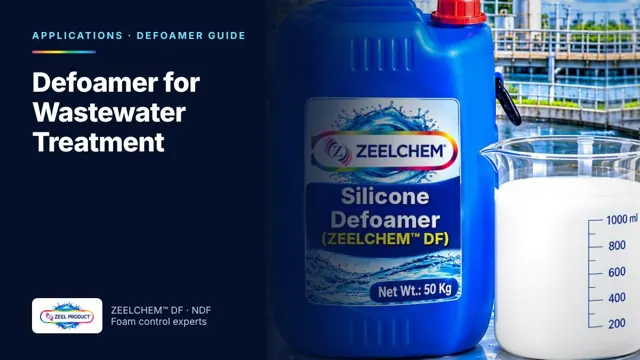
For effluent and sewage treatment, a silicone emulsion defoamer such as ZEELCHEM™ DF is the most common choice because it controls aeration-tank and equalisation-tank foam at low dosage. Dilute it with water, dose it continuously with a metering pump or spray it on the foam surface, and start low (tens of ppm) to avoid affecting biological treatment or oil-and-grease readings.
Why ETPs and STPs foam
- Detergents and surfactants in the influent (textile, chemical, pharma, food effluent).
- Vigorous aeration in activated sludge basins and MBBR tanks.
- Proteins and fats from food and dairy effluent.
- Filamentous bacteria foam (brown, sticky foam) at high sludge age.
- Free fall at inlets, weirs and clarifier outlets.
Where to dose
| Location | Method |
|---|---|
| Equalisation tank | Continuous metering into the inlet |
| Aeration tank | Spray nozzles over the surface, or dosing at the inlet channel |
| Anaerobic digester | Into recirculation line (check compatibility) |
| Final outlet / drains | Spot dosing at the foaming point |
Best practice
- Dilute ZEELCHEM™ DF with water at the ratio we recommend and use fresh dilution.
- Begin at a low dose and increase slowly until foam stays under control.
- Avoid big shock doses — excess oil-like material can rise to the surface.
- For biological foam, combine defoamer use with sludge-age control.
- Keep a dose log against flow rate to find the cost-optimal level.
Silicone or non-silicone for ETP?
Silicone emulsions are preferred for most ETP and STP foam because of their efficiency. A non-silicone fatty-alcohol or polyether defoamer may be used where effluent is reused for processes sensitive to silicone, or where a plant's consent conditions require it.
Frequently asked questions
Which defoamer is used in ETP?
Silicone emulsion defoamers are most widely used in ETPs because they control aeration foam at low dosage.
Does defoamer affect activated sludge bacteria?
At normal dosages a suitable defoamer does not harm activated sludge, but overdosing should be avoided and dosage should be optimised by trial.
How do I stop foam in an aeration tank?
Reduce surfactant load and air entrainment where possible, control sludge age, and dose a diluted defoamer by spray or metering pump.
Key takeaways
- Silicone emulsion = standard ETP/STP defoamer.
- Dilute, meter continuously, start low.
- Combine with process control for biological foam.
- Product page: silicone defoamer for industrial use (zeelproduct.com).
- Also see ZEELCHEM silicone defoamer product details on zeelproductonline.co.in.
- For silicone-sensitive processes: non-silicone antifoam supplier (zeelproductonline.co.in).