 By ZEELCHEM Technical Team · ZEEL PRODUCT, Vadodara
Published · Updated · 3 min read
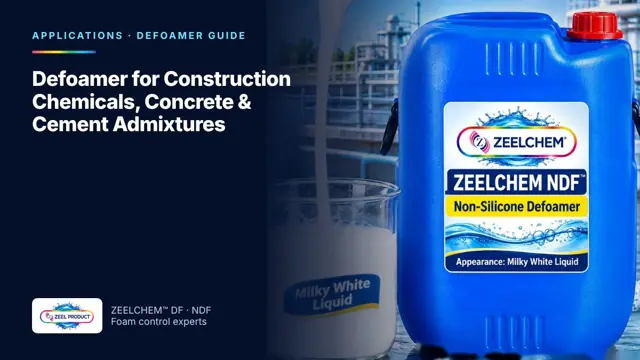
In construction chemicals, defoamers remove unwanted entrained air that weakens concrete and mortar and causes surface pores. They are used in PCE superplasticizer admixtures, self-levelling compounds, tile adhesives, grouts, waterproofing coatings and gypsum products. Non-silicone (polyether, mineral oil) defoamers are common in admixtures and coatings; powder defoamers are used in dry-mix mortars.
Why air is a problem
- Uncontrolled air lowers compressive strength.
- Surface bugholes and pinholes spoil fair-faced finishes.
- Self-levelling floors show craters.
- Waterproof coatings with bubbles have weak spots.
Applications
| Product | Defoamer type |
|---|---|
| PCE superplasticizer | Polyether / non-silicone, compatible with admixture |
| Self-levelling compound | Powder defoamer |
| Tile adhesive & grout | Powder defoamer |
| Acrylic / polymer waterproofing | Mineral-oil non-silicone (ZEELCHEM™ NDF) |
| Wall putty, gypsum | Powder or oil-based |
Note: intentional air entrainment for freeze–thaw resistance is a different requirement — do not remove that air. Always check admixture stability, because some defoamers separate from PCE solutions on storage.
Frequently asked questions
Why use defoamer in concrete admixture?
PCE superplasticizers can entrain unwanted air; a defoamer controls this to protect strength and finish.
Does defoamer increase concrete strength?
By reducing unwanted entrained air it can help achieve the designed strength.
Which defoamer for tile adhesive?
Powder defoamers designed for dry-mix mortars are typically used.
Key takeaways
- Defoamers remove unwanted air in concrete and mortar.
- Check stability in PCE solutions.
- Powder defoamers suit dry-mix products.
- Explore our non-silicone antifoam supplier on zeelproductonline.co.in.
- Need maximum foam knockdown instead? See this silicone antifoam emulsion supplier page on zeelproduct.net.