 By ZEELCHEM Technical Team · ZEEL PRODUCT, Vadodara
Published · Updated · 3 min read
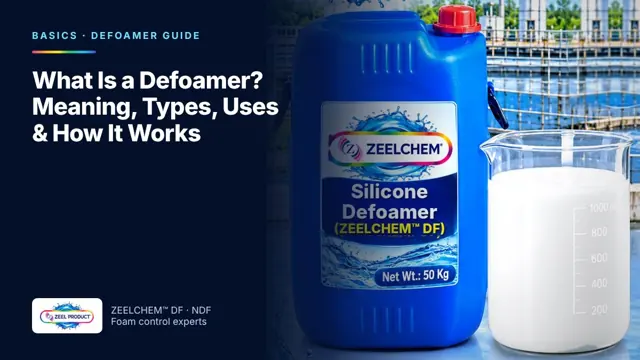
A defoamer (also called a defoaming agent or antifoaming agent) is a surface-active chemical added in small amounts to a liquid to destroy existing foam and stop new foam from forming. It works by spreading over bubble walls, thinning them until they rupture. The two main families are silicone defoamers (based on polydimethylsiloxane) and non-silicone defoamers (based on mineral oil, vegetable oil, fatty alcohols or polyethers).
Defoamer meaning in simple words
Foam is gas trapped in a liquid by a thin film that is stabilised by surfactants, proteins, polymers or fine solids. A defoamer is an insoluble, low-surface-tension liquid that gets into that film and breaks it. Industry uses the words defoamer, antifoam, antifoaming agent and foam control agent almost interchangeably, although strictly a defoamer knocks down foam that is already there and an antifoam prevents it from forming.
Why foam is a problem in industry
- Lost capacity — tanks, reactors and fermenters cannot be filled to working volume.
- Overflow and spills — foam carries product out of vessels, aeration basins and drains.
- Quality defects — pinholes and craters in paint, voids in concrete, spots on paper and textiles.
- Pump and instrument trouble — air in pumps causes cavitation; foam gives false level readings.
- Slower processing — washing, filtration, filling and draining all slow down.
Main types of defoamer
| Type | Active base | Typical strength | Common uses |
|---|---|---|---|
| Silicone defoamer (e.g. ZEELCHEM™ DF) | Polydimethylsiloxane (PDMS) + hydrophobic silica, usually as a water emulsion | Very effective at low ppm; works hot and cold, wide pH | Wastewater/ETP, textiles, detergents, chemicals, fermentation, food processing |
| Non-silicone defoamer (e.g. ZEELCHEM™ NDF) | Mineral oil, vegetable oil, fatty alcohol, ester or EO/PO polyether | Good knockdown, no silicone residue | Paints and coatings, paper and pulp, adhesives, inks, construction chemicals |
| Powder defoamer | Silicone or oil on a solid carrier | Dry blending | Cement and gypsum dry mixes, powder detergents |
How a defoamer works (short version)
A good defoamer has three properties: it is insoluble in the foaming liquid, it has a lower surface tension than the liquid, and it spreads fast over the bubble surface. A defoamer droplet enters the foam film, spreads, and pulls liquid away from the spot (the Marangoni effect). Hydrophobic particles such as silica then bridge the thinned film and de-wet it, and the bubble bursts. Our full guide on how defoamers work explains this step by step.
Where defoamers are used
Almost every water-based process can foam. The biggest users are effluent and wastewater treatment, paper and pulp, textile dyeing, paints and coatings, fermentation, sugar and distilleries, detergents, construction chemicals and agrochemicals.
How much defoamer is needed?
Usually very little — often in the range of 10 to 200 ppm (0.001–0.02%) of the system for strong silicone emulsions, and somewhat more for non-silicone types. The right dose depends on the foam, temperature, pH and how the defoamer is added. See our defoamer dosage guide.
Frequently asked questions
Is a defoamer the same as an antifoam?
In everyday use, yes. Technically, a defoamer destroys foam that has already formed and an antifoam prevents foam from forming, but most products, including ZEELCHEM™ DF and NDF, do both.
What is the most common defoamer?
Silicone emulsion defoamers based on polydimethylsiloxane are the most widely used, because they work at very low dosage over a wide range of temperature and pH.
Is defoamer harmful?
Industrial defoamers are generally low-hazard when used as directed, but always read the product's Safety Data Sheet (SDS) and use gloves and goggles when handling concentrates.
Key takeaways
- A defoamer is a low-surface-tension, insoluble additive that ruptures foam films.
- Silicone defoamers give the strongest effect per ppm; non-silicone defoamers avoid silicone-related defects.
- Dosage is typically small — confirm it with a trial on your own process liquid.
- Product page: silicone defoamer manufacturer in Vadodara (zeelproduct.net).
- Also see silicone antifoam emulsion supplier on zeelproduct.com.
- For silicone-sensitive processes: non-silicone defoamer online (zeelproductonline.co.in).