 By ZEELCHEM Technical Team · ZEEL PRODUCT, Vadodara
Published · Updated · 3 min read
Quick answer
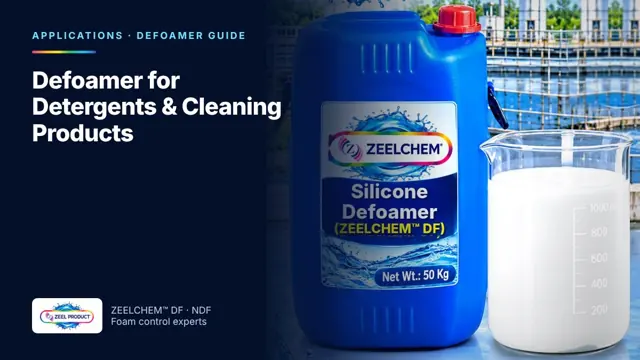
Detergent and cleaning-product makers use defoamers in two ways: as a process aid to control foam during mixing and filling, and as a formulation ingredient to make low-foam products such as machine-wash detergents, dishwasher products and CIP (clean-in-place) cleaners. Silicone antifoams are the most efficient; polyether types suit alkaline CIP and hard-surface cleaners.
Process aid uses
- Faster mixing without overflow.
- Accurate filling weights and no foam on bottle necks.
- Cleaner tank washing.
Formulation uses
| Product | Why low foam | Typical antifoam |
|---|---|---|
| Front-load laundry detergent | Foam reduces washing action | Silicone antifoam |
| Dishwasher detergent | Foam reduces spray pressure | Low-foam surfactants + antifoam |
| CIP cleaners | Foam blocks pumps and spray balls | Polyether or silicone |
| Floor-scrubber cleaners | Foam in recovery tank | Silicone emulsion |
Formulation tips
- Check stability of the antifoam in the finished product over shelf life.
- Strongly alkaline products need alkali-stable grades.
- Clear liquids may need a grade that does not cause haze.
Frequently asked questions
Why add antifoam to detergent?
To make low-foam products for machines, and to control foam during manufacturing and filling.
What antifoam is used in liquid detergent?
Silicone antifoam emulsions are common; the grade must be stable in the formula.
Is defoamer used in CIP cleaning?
Yes, to stop foam blocking pumps and spray devices; alkali-stable grades are needed.
Key takeaways
- Defoamers are both process aids and formula ingredients.
- Check shelf-life stability in the finished product.
- Pick alkali-stable grades for CIP.
More from ZEEL PRODUCT
- Product page: buy silicone defoamer online in India (zeelproductonline.co.in).
- Also see silicone defoamer for ETP and textile on zeelproduct.net.
- For silicone-sensitive processes: buy non-silicone defoamer in India (zeelproductonline.co.in).
Related searches: defoamer for detergentantifoam for detergentdefoamer for cleaning chemicalslow foam detergent antifoamcip defoamer