 By ZEELCHEM Technical Team · ZEEL PRODUCT, Vadodara
Published · Updated · 3 min read
Quick answer
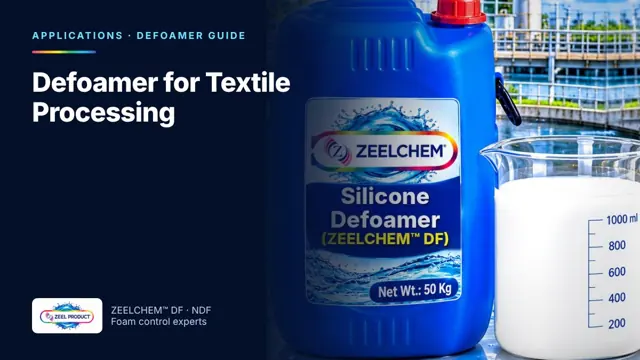
Textile mills need defoamers that are stable at high temperature, high shear and in alkaline or acidic dye baths, and that never leave spots on fabric. A shear-stable silicone emulsion like ZEELCHEM™ DF is the usual choice for jet and soft-flow dyeing, scouring and bleaching, dosed at the start of the cycle. Use a well-diluted product and avoid overdosing to prevent silicone spots.
Where foam appears in textile wet processing
- Jet and soft-flow dyeing machines — high speed circulation and surfactants.
- Scouring and bleaching — wetting agents and detergents at high pH and temperature.
- Washing-off — soaps and residual auxiliaries.
- Printing paste preparation — trapped air causes print defects.
- Textile ETP — heavy surfactant load.
What a textile defoamer must do
| Requirement | Why |
|---|---|
| High-temperature stability (up to 130 °C in HT dyeing) | Must not break down or separate |
| Shear stability | Jet machines can break weak emulsions and cause oily spots |
| Wide pH tolerance | Alkaline scouring, acid dyeing |
| No spotting or staining | Fabric quality |
| Compatibility with dyes and auxiliaries | No precipitation or shade change |
Avoiding silicone spots
- Pre-dilute the defoamer with water before adding to the machine.
- Add through the addition tank, not directly onto fabric.
- Use the minimum effective dose; record it per recipe.
- Keep the drum closed and stir before use.
Frequently asked questions
Which defoamer is best for jet dyeing?
A high-temperature, shear-stable silicone emulsion defoamer is usually best for jet and soft-flow dyeing.
Why do silicone defoamers cause spots on fabric?
Poor dilution, overdosing or an unstable emulsion can let silicone oil separate and deposit on fabric.
When should defoamer be added in dyeing?
Usually at the start of the cycle, pre-diluted, before foam builds up.
Key takeaways
- Textiles need heat-, shear- and pH-stable defoamers.
- Pre-dilute and dose via the addition tank.
- Use the minimum effective dose to prevent spots.
More from ZEEL PRODUCT
- Product page: silicone antifoam emulsion supplier (zeelproduct.net).
- Also see silicone defoamer manufacturer in Vadodara on zeelproduct.com.
- For silicone-sensitive processes: silicone-free defoamer for paints and paper (zeelproductonline.co.in).
Related searches: textile defoamerdefoamer for textile industryantifoam for jet dyeingdefoamer for dyeingsilicone defoamer textile