 By ZEELCHEM Technical Team · ZEEL PRODUCT, Vadodara
Published · Updated · 3 min read
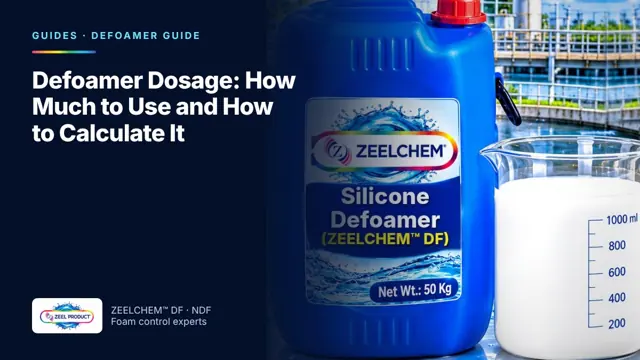
Typical defoamer dosages are small: silicone emulsion defoamers often work at about 10–200 ppm of the system, and non-silicone defoamers at about 0.05–0.5% depending on the application. Calculate the dose as flow rate × ppm ÷ 1,000,000 to get kg per hour, start at the low end, and increase in small steps until foam is controlled.
Typical starting ranges
| Application | Typical starting range* |
|---|---|
| ETP / STP (silicone emulsion) | 10–100 ppm on flow |
| Textile dyeing | 0.1–0.5 g/L of bath |
| Detergent manufacture | 0.01–0.1% on batch |
| Water-based paint (non-silicone) | 0.1–0.5% on total formula |
| Fermentation | On demand via foam probe |
*Indicative only. The right dose depends on your system — always confirm with a trial.
How to calculate dose
kg/h of defoamer = flow (m³/h) × dose (ppm) ÷ 1,000 (because 1 m³ of water ≈ 1,000 kg, and ppm = mg/kg = g/m³).
Example: an ETP treating 50 m³/h at 20 ppm needs 50 × 20 = 1,000 g/h = 1 kg/h of defoamer as supplied. If you dilute it 1:10 with water, set the pump at about 11 L/h of dilution.
Batch calculation
For a 5,000 L batch at 0.05%: 5,000 × 0.0005 = 2.5 kg.
Optimising
- Start low, increase by 25–50% steps.
- Record foam height and dose against time.
- Dose continuously rather than in big shots where possible.
- Re-check after any process change.
Frequently asked questions
How many ppm of defoamer should I use?
Silicone emulsions often work at roughly 10–200 ppm, but confirm the dose with a trial in your system.
How do I convert ppm to kg per hour?
Multiply flow in m³/h by ppm and divide by 1,000 to get kg/h.
Can too much defoamer cause problems?
Yes — overdosing wastes money and can cause spots, craters, oily layers or downstream issues.
Key takeaways
- Typical doses are small — tens to hundreds of ppm.
- kg/h = m³/h × ppm ÷ 1,000.
- Start low, optimise, re-check after changes.
- Product page: silicone antifoam emulsion supplier (zeelproduct.net).
- Also see silicone defoamer manufacturer in Vadodara on zeelproduct.com.
- For silicone-sensitive processes: silicone-free defoamer for paints and paper (zeelproductonline.co.in).