 By ZEELCHEM Technical Team · ZEEL PRODUCT, Vadodara
Published · Updated · 3 min read
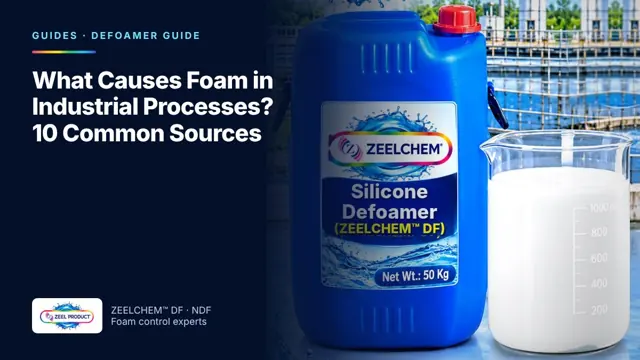
Industrial foam forms when gas is mixed into a liquid that contains foam-stabilising substances. The most common causes are surfactants and detergents, proteins and biological matter, polymers and starches, fine solids, aeration and vigorous agitation, pumping and free-falling liquids, temperature and pressure changes, and gas produced by fermentation or chemical reactions.
The 10 most common causes
- Surfactants and detergents — wetting agents, soaps and cleaning chemicals.
- Proteins — food, dairy, fermentation broths, slaughterhouse effluent.
- Polymers and starch — sizing agents, thickeners, latex binders.
- Fine solids — stabilise bubble walls (Pickering foam).
- Aeration — air blowers and diffusers in biological treatment.
- High-shear mixing — dispersers, homogenisers, jet dyeing machines.
- Pumping and free fall — liquid falling into tanks traps air.
- Gas generation — CO2 from fermentation or neutralisation reactions.
- Temperature/pressure changes — dissolved gas comes out of solution.
- Biological foaming — filamentous bacteria such as Nocardia in activated sludge.
Control at the source first
- Fill tanks from the bottom or via a dip pipe to avoid free fall.
- Check pump seals and suction lines for air leaks.
- Avoid overdosing surfactants and wetting agents.
- In ETPs, manage sludge age and F/M ratio to reduce biological foam.
Then add the right defoamer
When process changes are not enough, a defoamer gives fast, economical control. Match the chemistry to the foam source: silicone (ZEELCHEM™ DF) for most water-based industrial foam, non-silicone (ZEELCHEM™ NDF) where silicone is not wanted.
Frequently asked questions
What chemicals cause foaming?
Surfactants, detergents, proteins, saponified fats, starches, polymers and some fine solids are the most common foam stabilisers.
Why does foam form in aeration tanks?
Air bubbles from diffusers combine with surfactants, proteins and filamentous bacteria to form stable foam.
Can foam be prevented without chemicals?
Partly — by reducing air entrainment and surfactant load — but a defoamer is usually the most reliable and economical control.
Key takeaways
- Foam = gas + liquid + a foam stabiliser.
- Fix air entrainment and surfactant overdosing first.
- Match defoamer chemistry to the foam source.
- Product page: silicone defoamer manufacturer in Vadodara (zeelproduct.net).
- Also see silicone antifoam emulsion supplier on zeelproduct.com.
- For silicone-sensitive processes: buy non-silicone defoamer in India (zeelproductonline.co.in).