 By ZEELCHEM Technical Team · ZEEL PRODUCT, Vadodara
Published · Updated · 3 min read
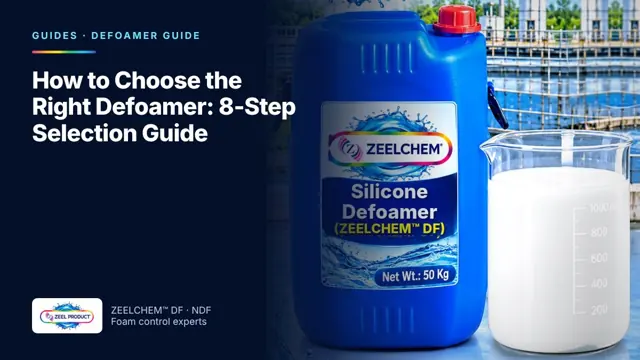
To choose the right defoamer: (1) identify what causes the foam, (2) note temperature, pH and shear, (3) list restrictions such as silicone-free or food-grade, (4) decide whether you need knockdown, persistence or air release, (5) shortlist silicone and non-silicone options, (6) test them in your actual liquid, (7) check side effects, and (8) compare cost-in-use, not price per kg.
The 8 steps
- Identify the foam source — surfactant, protein, polymer, biological, gas evolution.
- Record conditions — temperature, pH, shear, solids, water vs oil phase.
- List restrictions — silicone-free, food contact, effluent rules, customer specs.
- Define the job — quick knockdown, long persistence, deaeration, or all three.
- Shortlist chemistry — silicone (DF) vs non-silicone (NDF) and sub-types.
- Test in your liquid — shake, sparge or cylinder test at real temperature.
- Check side effects — spotting, craters, haze, separation, effect on biology.
- Compare cost-in-use — dose × price per kg = cost per batch or per m³.
Quick selector
| Your situation | Start with |
|---|---|
| ETP / STP aeration foam | ZEELCHEM™ DF (silicone emulsion) |
| Textile dyeing, scouring | ZEELCHEM™ DF |
| Detergent manufacturing | ZEELCHEM™ DF |
| Water-based paint, primer, putty | ZEELCHEM™ NDF |
| Paper machine wet end | ZEELCHEM™ NDF |
| Adhesives, inks, latex | ZEELCHEM™ NDF |
| Hot process, foam above set temperature | Polyether NDF grade |
Share your process details and our team will recommend a grade and dose — contact us or try the dosing calculator.
Frequently asked questions
How do I know which defoamer to use?
Start from the foam source and process conditions, then test silicone and non-silicone options in your own liquid.
What information does a defoamer supplier need?
Industry, process step, temperature, pH, foam source, restrictions (silicone-free, food-grade) and current product/dose if any.
Is the cheapest defoamer the most economical?
Not always. A more concentrated product at a lower dose may cost less per batch.
Key takeaways
- Define foam source, conditions and restrictions first.
- Always test in your actual liquid.
- Decide on cost-in-use.
- Product page: buy silicone defoamer online in India (zeelproductonline.co.in).
- Also see silicone defoamer for ETP and textile on zeelproduct.net.
- For silicone-sensitive processes: non-silicone defoamer online (zeelproductonline.co.in).