 By ZEELCHEM Technical Team · ZEEL PRODUCT, Vadodara
Published · Updated · 3 min read
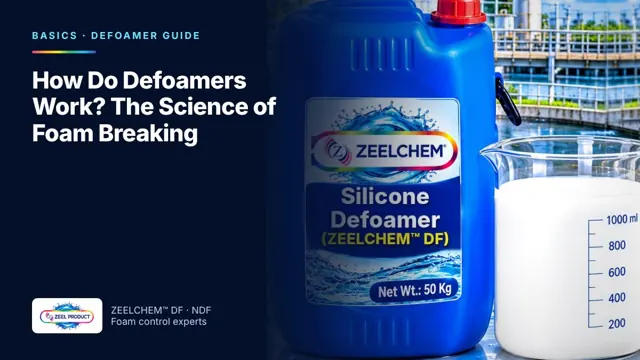
Defoamers work because their droplets are insoluble in the foaming liquid and have lower surface tension. A droplet enters the bubble film, spreads over its surface and drags liquid away (Marangoni flow), thinning the film. Hydrophobic particles or the droplet itself then bridge both sides of the film and de-wet it, so the film ruptures and the bubble bursts.
Why foam is stable in the first place
Pure water hardly foams. Foam becomes stable when surfactants, proteins, polymers or fine solids collect at the air–water surface. They create surface elasticity (the Gibbs–Marangoni effect) that heals thin spots, and they slow down the drainage of liquid out of the bubble walls.
The four steps of defoaming
- Transport — the defoamer droplet must reach the bubble surface. Good dispersion matters here.
- Entering — the droplet must break into the air–liquid surface. This is favourable when the entering coefficient E = γw + γwo − γo is positive (γw: liquid surface tension, γo: defoamer surface tension, γwo: interfacial tension).
- Spreading — if the spreading coefficient S = γw − γwo − γo is positive, the defoamer spreads as a lens or film, dragging liquid with it and thinning the wall.
- Bridging and de-wetting — a droplet or hydrophobic particle touches both faces of the thin film; because it is not wetted, the film pulls away from it and breaks.
Why silica makes silicone defoamers so strong
PDMS oil alone defoams only modestly. Fine hydrophobic silica particles inside the oil droplets help the droplets pierce the "pseudo-emulsion film" between droplet and bubble, which is the barrier that normally stops oil entering. This oil–particle synergy is why compounded silicone defoamers work at very low dosage.
Polyether cloud-point defoaming
EO/PO polyether defoamers dissolve in cold water but become insoluble above their cloud point. Above that temperature they form droplets that behave like an oil defoamer — useful for hot processes and fermentation.
Why defoamers lose effect over time
With shear and time, droplets can be emulsified into very small sizes or the hydrophobic particles can become wetted, so the defoamer is "exhausted". That is why persistence differs between products and why continuous or repeated dosing may be needed.
Chemical structure
Frequently asked questions
What is the bridging-dewetting mechanism?
A defoamer droplet or hydrophobic particle spans both surfaces of a thin foam film; the liquid de-wets it, the film thins to zero at that point and ruptures.
Why must a defoamer be insoluble?
A dissolved additive cannot form droplets or particles that enter and bridge the foam film, so it cannot break the bubble.
What does hydrophobic silica do in a defoamer?
It helps oil droplets break into the foam film and acts as a bridging particle, greatly increasing efficiency.
Key takeaways
- Defoaming = transport, entering, spreading, bridging/de-wetting.
- Low surface tension and insolubility are essential.
- Silica + silicone oil synergy explains silicone's strength.
- Product page: silicone defoamer for ETP and textile (zeelproductonline.co.in).
- Also see buy silicone defoamer online in India on zeelproduct.net.
- For silicone-sensitive processes: silicone-free defoamer for paints and paper (zeelproductonline.co.in).