 By ZEELCHEM Technical Team · ZEEL PRODUCT, Vadodara
Published · Updated · 3 min read
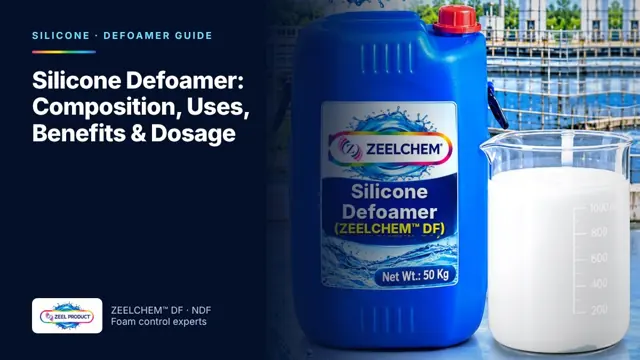
A silicone defoamer is a foam control agent based on polydimethylsiloxane (PDMS) silicone oil combined with hydrophobic silica, usually supplied as a white water-dilutable emulsion. It has very low surface tension and is insoluble in water, so it spreads quickly over foam and bursts bubbles at very low dosage, working across a wide range of temperature and pH.
What a silicone defoamer is made of
- Silicone oil (PDMS) — the active, low-surface-tension liquid (about 20–21 mN/m versus 72 mN/m for water).
- Hydrophobic silica — fine particles that pierce and de-wet foam films; together with PDMS this forms a "silicone compound".
- Emulsifiers — non-ionic surfactants that let the compound be dispersed in water.
- Water, thickener and preservative — to give a stable, pumpable emulsion.
Grades are described by active content — for example 10%, 20% or 30% silicone emulsion — or as 100% silicone compound or silicone oil for oil-based systems.
Chemical structure
Benefits of silicone defoamers
- Effective at very low dosage — often a few ppm to a few hundred ppm.
- Fast knockdown and long persistence.
- Works in hot and cold systems and across acidic to alkaline pH.
- Chemically inert and non-ionic, so it rarely reacts with the process.
- Easy to dilute with water and dose with standard pumps.
Where silicone defoamer is used
| Industry | Typical foam source |
|---|---|
| Effluent & wastewater (ETP/STP) | Aeration, surfactants, biological activity |
| Textile processing | Jet dyeing, scouring, bleaching, washing |
| Detergent & chemical plants | Mixing, reactors, filling |
| Fermentation & distilleries | Proteins and CO2 evolution |
| Food processing | Washing and boiling starch, potato, pulses (food-suitable grades only) |
| Agrochemicals | Formulation and tank mixing |
Limitations to know
Silicone is so effective at lowering surface tension that, in some systems, it can cause surface defects such as craters or "fish-eyes" in paints, or interfere with recoating and printing. Overdosing or poor dilution can also cause oily spots. In those applications a non-silicone defoamer is often preferred — see our comparison.
How to use a silicone defoamer
- Stir the drum gently before use; emulsions can cream on standing.
- If diluting, add the defoamer to cold or room-temperature water while stirring — not water into defoamer — and use the dilution within the time stated by the supplier.
- Dose at the point where foam is generated, or just before it.
- Start low and increase until foam is controlled; record the minimum effective dose.
Frequently asked questions
What is silicone defoamer made of?
Mainly polydimethylsiloxane (silicone oil) with hydrophobic silica, emulsified in water with non-ionic emulsifiers.
How do you dilute a silicone defoamer?
Add the emulsion slowly to clean cold or room-temperature water while stirring, at the ratio your supplier recommends, and use the dilution within the stated time.
Can silicone defoamer be used in food?
Only grades specifically made and documented for food contact or food processing should be used. Ask ZEEL PRODUCT for the right grade and documents.
Key takeaways
- Silicone defoamer = PDMS + hydrophobic silica, usually a water emulsion.
- Strongest foam control per ppm, wide pH and temperature range.
- Avoid in systems sensitive to silicone defects — use non-silicone there.
- Product page: buy silicone defoamer online in India (zeelproductonline.co.in).
- Also see silicone defoamer for ETP and textile on zeelproduct.net.
- For silicone-sensitive processes: buy non-silicone defoamer in India (zeelproductonline.co.in).