 By ZEELCHEM Technical Team · ZEEL PRODUCT, Vadodara
Published · Updated · 3 min read
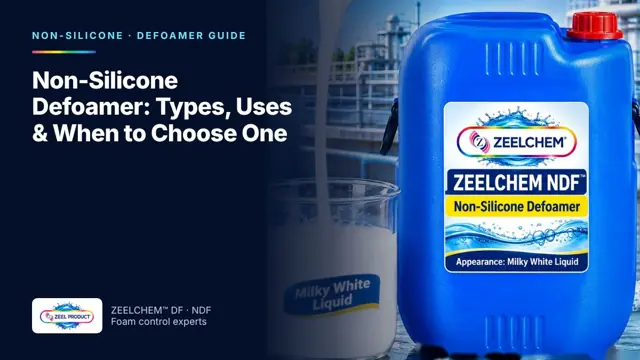
A non-silicone defoamer is a foam control agent that contains no silicone. Instead it uses mineral oil, vegetable oil, fatty alcohols, esters, waxes or EO/PO polyether polymers as the active. It is chosen where silicone could cause surface defects, poor adhesion or recoating problems — for example in paints, coatings, inks, adhesives, paper and some construction chemicals.
Main types of non-silicone defoamer
| Type | How it works | Best for |
|---|---|---|
| Mineral oil based | Oil + hydrophobic particles/waxes spread on foam films | Paints, latex, adhesives, construction |
| Vegetable oil / ester based | Similar to mineral oil, from renewable oils | Formulations where a bio-based or lower-VOC option is wanted |
| Fatty alcohol emulsions | Fatty alcohol droplets destabilise foam | Paper and pulp, starch, wastewater |
| Polyether (EO/PO block copolymer, polyglycol) | Cloud-point behaviour: becomes insoluble above a temperature and then defoams | Fermentation, hot processes, detergents, metalworking fluids |
Chemical structures
Mineral-oil grades use paraffinic hydrocarbons (CₙH₂ₙ₊₂) with hydrophobic waxes. Structures show the typical active chemistries of non-silicone defoamers; the exact ZEELCHEM™ NDF composition depends on grade.
When to choose a non-silicone defoamer
- Your coating, ink or adhesive shows craters, fish-eyes or poor intercoat adhesion.
- The product will be printed, painted, laminated or glued afterwards.
- Customer or industry specifications say "silicone-free".
- Paper machines where silicone deposits or sizing issues are a concern.
- Hot processes where a polyether's cloud point gives automatic foam control.
Trade-offs
Non-silicone defoamers usually need a higher dose than silicone emulsions for the same effect, and the choice of chemistry must match the system — a mineral-oil defoamer that works perfectly in one emulsion paint may be too strong or too weak in another. Testing is essential; see how to choose the right defoamer.
Frequently asked questions
What is a non-silicone defoamer?
A foam control agent made without silicone, using mineral oil, vegetable oil, fatty alcohols, esters or polyether polymers as the active ingredient.
Is non-silicone defoamer better than silicone?
Not universally. It is better where silicone causes defects or is not allowed; silicone is usually stronger per ppm elsewhere.
What is a polyether defoamer?
An EO/PO block copolymer or polyglycol that becomes insoluble above its cloud point and then acts as a defoamer, useful in hot processes and fermentation.
Key takeaways
- Non-silicone defoamers use oils, fatty alcohols, esters or polyethers.
- Choose them for coatings, inks, adhesives, paper and silicone-free specs.
- Expect higher dosage than silicone — test in your system.
- Explore our non-silicone antifoam supplier on zeelproductonline.co.in.
- Need maximum foam knockdown instead? See this silicone antifoam emulsion supplier page on zeelproduct.net.